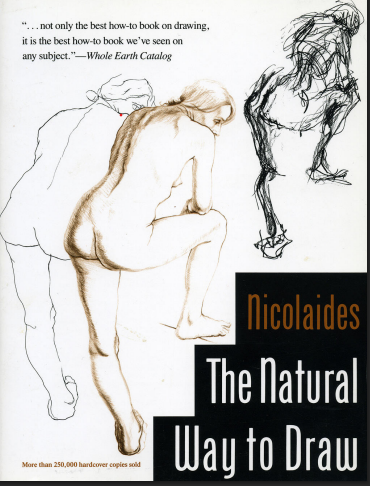
Publisher’s Note
“WHEN Kimon Nicolaïdes died in the summer of 1938, the first draft of this book had been complete for two years. It could, perhaps, never have been published other than posthumously, for the author was reluctant to put into final form his constantly developing methods of art teaching.”
Introduction
The Only Way to Learn to Draw Is by Observation
“There is only one right way to learn to draw and that is a perfectly natural way. It has nothing to do with artifice or technique. It has nothing to do with aesthetics or conception. It has only to do with the act of correct observation, and by that I mean a physical contact with all sorts of objects through all the senses. If a student misses this step and does not practice itvfor at least his first five years, he has wasted most of his time and must necessarily go back and begin all over again.
The Art Teacher’s Job Is Not to Teach the Student How to Draw but How to Learn to Draw for Himself
“The job of the teacher, as I see it, is to teach students, not how to draw, but how to learn to draw. They must acquire some real method of finding out facts for themselves lest they be limited for the rest of their lives to
facts the instructor relates. They must discover something of the true nature of artistic creation – of the hidden processes by which inspiration works.
“The knowledge – what is to be known about art – is common property. It is in many books. What the teacher can do is to point out the road that leads to accomplishment and try to persuade his students to take that road.
This cannot be a matter of mere formula.
“My whole method consists of enabling students to have an experience. I try to plan for them things to do, things to think about, contacts to make. When they have had that experience well and deeply, it is possible to point
out what it is and why it has brought these results.
‘The supreme misfortune is when
theory outstrips performance.’
Leonardo da Vinci
“Don’t worry if for the first three months your studies do not look like anything else called a drawing that you have ever seen. You should not care what your work looks like as long as you spend your time trying.
The effort you make is not for one particular drawing, but for the experience you are having – and that will be true even when you are eighty years old.
I believe that entirely too much emphasis is placed upon the paintings and drawings that are made in art schools. If you go to a singing teacher, he will first give you breathing exercises, not a song. No one will expect
you to sing those exercises before an audience. Neither should you be expected to show off pictures as a result of your first exercises in drawing….
Your progress In learning art is charted… in the increased knowledge with which you look at life around you.
“Unfortunately most students, whether through their own fault or the fault of their instructors, seem to be dreadfully afraid of making technical mistakes. You should understand that these mistakes are unavoidable.
THE SOONER YOU MAKE YOUR FIRST FIVE THOUSAND MISTAKES, THE SOONERYOU WILL BE ABLE TO CORRECT THEM.
Section 1. Contour and Gesture
EXERCISE 1: CONTOUR DRAWING
EXERCISE 2: GESTURE DRAWING
EXERCISE 3: CROSS CONTOURS
Section 1
Contour and Gesture
CORRECT OBSERVATION.
The first function of an art student is to observe–to study nature.
The artist’s job in the beginning is not unlike the job of a writer. He must first reach out for raw material. He must spend much time making contact with actual objects.
Learning to draw is really a matter of learning to see – to see correctly – and that means a good deal more than merely looking with the eye.
The sort of ‘seeing’ I mean is an observation that utilizes as many of the five senses as can reach through the eye at one time. Although you use your eyes, you do not close up the other senses – rather, the reverse, because
all the senses have a part in the sort of observation you are to make. For example, you know sandpaper by the way it feels when you touch it. You know a skunk more by odor than by appearance, an orange by the way it
tastes. You recognize the difference between a piano and a violin when you hear them over the radio without seeing them at all.
Because pictures are made to be seen, too much emphasis (and too much dependence) is apt to be placed upon seeing. Actually, we see through the eyes rather than with them. It is necessary to test everything you see with
what you can discover through the other senses – hearing, taste, smell, and touch – and their accumulated experience. If you attempt to rely on the eyes alone, they can sometimes actually mislead you.
I think you will realize that this is true if you imagine that a man from Mars or some planet totally different from ours is looking for the first time at a landscape on the earth. He sees what you see, but he does not know what you know. Where he sees only a square white spot in the distance, you recognize a house having four walls within which are rooms and people. A cock’s crow informs you that there is a barnyard behind the house. Your
mouth puckers at the sight of a green persimmon which may look to him like luscious fruit or a stone.. . . .
THE SENSE OF TOUCH. Merely to see, therefore, is not enough. It is necessary to have a fresh, vivid, physical contact with the object you draw through as many of the senses as possible – and especially through the
sense of touch.
Our understanding of what we see is based to a large extent on touch. Advertising experts realize this and place sample objects in stores where people can touch them. If you close your eyes and someone puts into your
hand an object that you haven’t seen, you can doubtless tell what that object is without opening your eyes. You can probably draw it from the experience of touch without ever having seen it. If you go into a dark room to get
a book, you will not bring back a vase by mistake even though the two are side by side.
How to Create Blind Contour Drawings
“Sit close to the model or object which you intend to draw and lean forward in your chair. Focus your eyes on some point – any point will do along the contour of the model. (The contour approximates what is usually
spoken of as the outline or edge.) Place the point of your pencil on the paper. Imagine that your pencil point is touching the model instead of the paper. Without taking your eyes off the model, wait until you are convinced
that the pencil is touching that point on the model upon which your eyes are fastened.
“Then move your eye slowly along the contour of the model and move the pencil slowly along the paper. As you do this, keep the conviction that the pencil point is actually touching the contour. Be guided more by the sense
of touch than by sight.
THIS MEANS THAT YOU MUST DRAW WITHOUT LOOKING AT THE PAPER, Continuously looking at the model. Exactly coordinate the pencil with the eye. Your eye may be tempted at first to move faster than your pencil, but do not let it get ahead. Consider only the point that you are working on at the moment with no regard
for any other part of the figure.
[NOTE: Jacki Kellum’s contour drawings are a modification of the Nicolaides Blind Contour method.]
A contour drawing is like climbing a mountain as contrasted with flying over it in an airplane. It is not a
quick glance at the mountain from far away but a slow, painstaking climb over it, step by step.
Do not worry about the ‘proportions’ of the figure. That problem will take care of itself in time. And
do not be misled by shadows. When you touch the figure, it will feel the same to your hand whether the part
you touch happens at the moment to be light or in shadow. Your pencil moves, not on the edge of a shadow,
but on the edge of the actual form.
This exercise should be used in drawing subjects of all sorts….a flower, a stone, a piece
of fruit, or an old shoe. Draw yourself by looking the mirror. your own hand or foot….

Draw anything.

CONTOUR VERSUS OUTLINE.
We think of an outline as a diagram or silhouette, flat and two-dimensional. It is the sort of thing you make when you place your hand flat on piece of paper and trace around the fingers with a pencil – you cannot even tell from the drawing whether the palm or the back of the hand faced downward.
Contour has a three-dimensional quality; that is, it indicates the thickness as well as the length and width of the
form it surrounds. We do not think of a line as contour unless it follows the sense of touch, whereas an outline may follow the eye alone.

Place two apples on a table,one slightly in front of the otherbut not touching it, as in Figure
1. Figure 2 shows the visual outline of both apples.
Figure 3 shows the visual outline of the second app!e.
Neither Figure 2 nor Figure 3 could possibly be a contour drawing because, in both, the line follows the eye and not the sense of touch.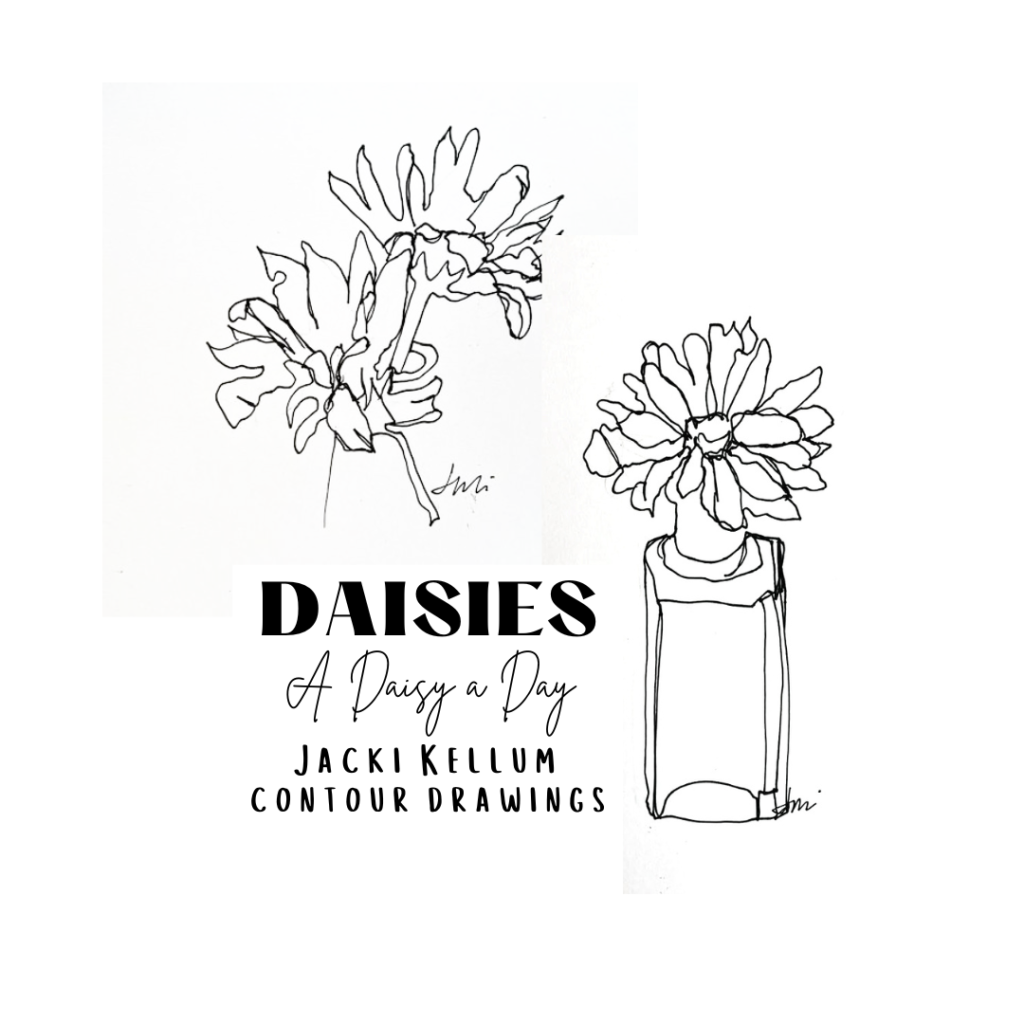
Most of Jacki Kellum’s Drawings Are a Modification of the Nicolaides Bind Contour
At one time, I did blind contour drawings, but at this point, I allow myself to glance down at my paper. To keep my eyes and hand linked together and also to prevent a shift of my perspective, I lock my head in a fixed position and allow only my eyes to glance down at my paper.
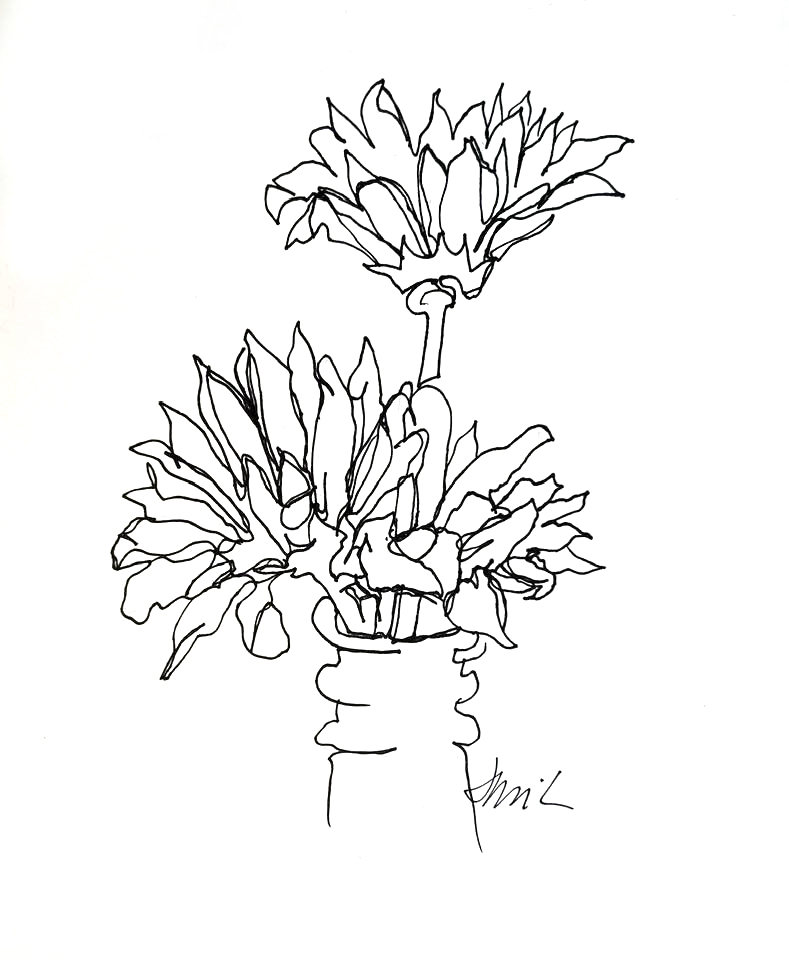
I also do not pick up my pen or pencil.
Contour Drawing Helps Me to Better See What I Want to Paint – Frederick Franck on Zen Drawing
Method{|https://oscarcerrato.wordpress.com/wp-content/uploads/2017/06/the-natural-way-to-draw.pdf
Discover more from Jacki Kellum
Subscribe to get the latest posts sent to your email.