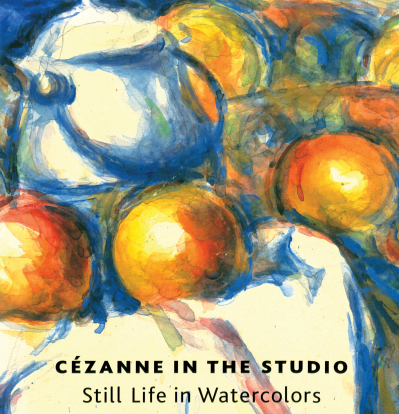
“Paul Cezanne’s role as the heroic progenitor of modernism stems largely from the achievement of his monumental paintings in oil. But another part of his oeuvre reveals an artistic personality that, while less lionized in the annals of art and its history, is more human and approachable than the Cezanne we think we know These qualities emerge in the medium of watercolor, where the brilliant white of the paper surface, the silvery line of shahiurpened graphite, and the translucent brilliance of liquid color seem to imbue his famously struggling temperament with a lighter sense of being.
[Note: I highly recommend that you read this free-to-download publication from the Getty Museum. It provides a quick biography of Paul Cezanne and perhaps more importantly, it explains how to elect to create art–especially still lifes–that tell stories about oneself]
The significance of Cezanne’s studio is crucial
“Cezanne’s celebration of the kaleidoscopic interaction of the ethreal elements of color, line, and light finds pure expression in his monumental late watercolor Still Life with Blue Pot in the Getty Museum. It is a work of such brilliance that we decided to make it the focus of a book. As the project developed, however, it became clear that Cezanne’s watercolor still lifes were at once so profound and glorious that they merited an exhibition. Cezanne in the Studio: Still Life in Watercolors explores the intersection of the genre of still life-and the medium familiar environment that Cezanne painted his still lifes. Anyone who has visited his final studio at Les Lauves, just outside the old town of Aix-en-Provence, cannot fail to be moved by the contrast between the humble, simple surviving still-life objects and the splendid, profound watercolor The significance of the studio is crucial, since it was in this controlled, familiar environment that Cezanne painted his still lifes. Anyone who has visited his final studio at Les Lauves, just outside the old town of Aix-en-Provence, cannot fail to be moved by the contrast between the humble, simple surviving still-life objects and the splendid, profound watercolors that they inspired. In his studio—filled with faience, tapestries, and furniture from his beloved Provence—this spartan individual composed still lifes of unabated sensual attraction. It was at Les Lauves that Cezanne painted his late still lifes in watercolor, among the masterpieces of his oeuvre.” DEBORA H GRIBBON Director J. Paul Getty Museum – Vice President, J. Paul Getty Trust [pg. ix]
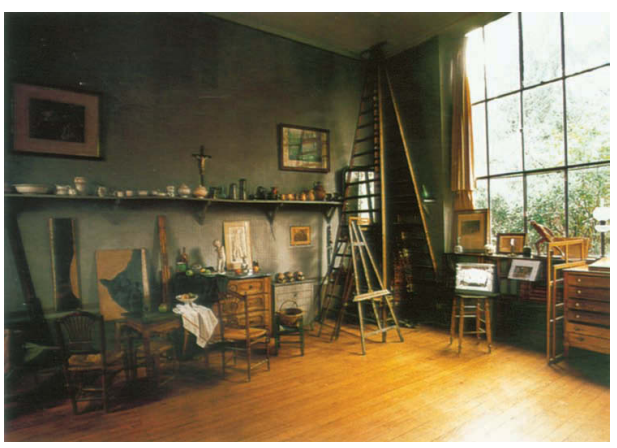
Cezanne’s studio at Les Lauves
Just outside the old town of Aix-en-Provence
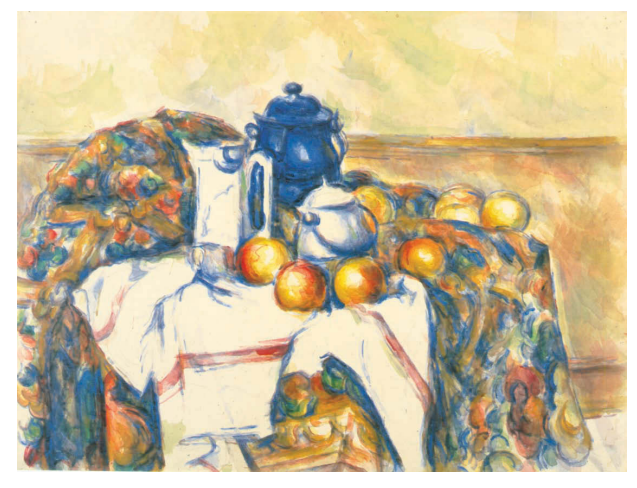
Still Life with a Blue Pot
Paul Cezanne
1900-1906
Watercolor and graphite on white wove paper,
48.1 x 63.2 cm
about 18″ x 24″
Los Angeles, J. Paul Getty Museum
“Like many a still life, Paul Cezanne’s Still Life with Blue Pot (pi. 1) gets its name from among its inventory of objects, in this case the blue enamel pot that forms the summit of the composition. Its objects are plain and simple, remarkably unremarkable when seen in their diminished reality in Cezanne’s last studio in Aix-en Provence, where many of them still dwell. Yet the still life that these simple objects compose is a magnificent thing: executed in graphite and watercolor but large in dimensions for its medium, it is of the size and spaciousness of a landscape, complex in both its arrangement of volumes and patterns and in its layering of watercolor tints and touches, gorgeous in its raiment of stained glass effects. Much more than a study, it is a full-fledged picture, carefully plotted and elaborately crafted, as finished as any of the painter’s late works ever were, and more sensuously satisfactory than many of his oils.Indeed, though it resides in the drawings collection of the J. Paul Getty Museum,
Cezanne’s watercolor has pencil lines sewn through its translucent paint
“…and though it has pencil lines sewn through its translucent cobalts, reds, ochers, and greens, it is a painting at least as much as it is a drawing.
Still life is the category of painterly subject matter that occupies the lowest rung on the ladder of the old hierarchy of genres
“As memorable as it is, however, Cezanne’s Still Life with Blue Pot is lowly on two counts: its genre and its medium. A still life in watercolors, after all, is hardly the stuff of momentous art as it is usually conceived. Still life is the category of painterly subject matter that occupies the lowest rung on the ladder of the old hierarchy of genres: devoted to inanimate things and subject matter, thought to be devoid of invention and narrative import, tied to the humble activities of the home or the quotidian exercises of the studio, it is to history and mythological painting and all subjects based in the human body as guttersnipe is to hero, scullery maid to king.
“Likewise, watercolor on paper is to oil on canvas as holiday gear is to formal wear: the sketchbook materials of the student, the amateur, and the dilettante, of the artist’s private note taking, the English hobbyist’s leisurely pursuit, the lady’s flower or landscape jotting, not the matter of high value, public esteem, complex craft and finish.2
“Usually dependent on immediacy, brevity, and a quick, sure touch, watercolor defies the layered labor of oil painting. Like still life, it tends to be relatively small in size. Like still life, it has something of the feminine about it. As with still life, moreover, its subjects are generally of low standing. And as with still life, so with watercolor: it is neither that genre nor that medium that we think of when we think of Cezanne as the titanic figure who inaugurated the great and storied struggles of the modernist tradition. …
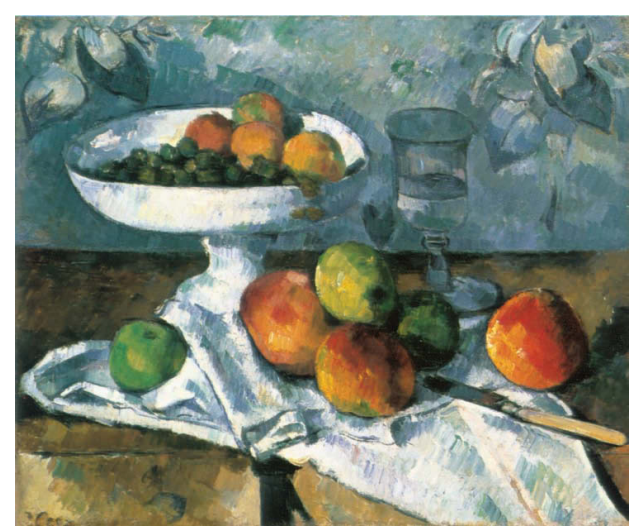
Paul Cezanne
Still Life with Compotier, 1880
Oil on canvas, 46 x 55 cm
(i81/s x 215/8 in.
Private collection
How Cezanne’s Still Life Paintings Are Self-Portraits–A Biography
…substitute a screen of regularized paint strokes and an Impressionist-inflected, lightened-up palette for the dark density of the earlier work. They also begin to open up the space around their narrow shelves of objects to a degree, by the traditional means of projecting knife and drawer handles. The leafy blue-green wallpaper in the 1880 still life evokes the air and verdure of the outdoors. Meanwhile, a half-full glass of water still suggests that someone might pick it up and drink it, while the knife suggests that someone might cut one of the apples, and the dark, outward-projecting drawer handle, with its peculiarly diminished prong of shadow, suggests that we ourselves might be tempted to stretch out a hand, pull it, and look inside. For his part, Fry saw that black handle and its shadow as a flaw in Cezanne’s composition, a defect (something like a facial tic) that marred the obviously consistent “handwriting” of the rest and thus impugned the expressionist logic of the still life’s “deformations”—namely, its diagonal brushwork and the stretched-out contours of its objects. …
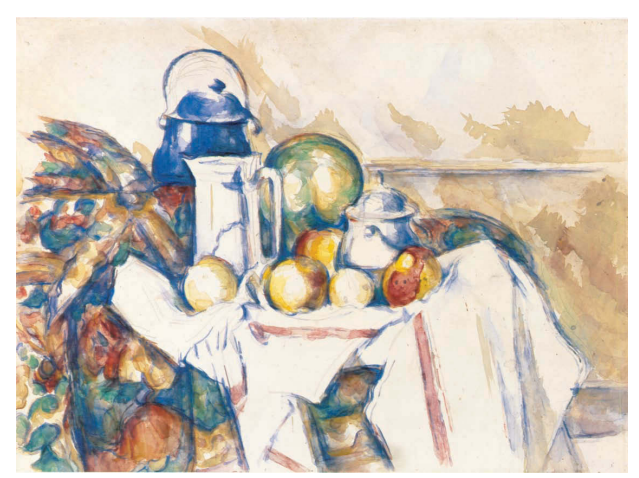
Still Life with Milk Pot, Melon, and Sugar Bowl,
1900-1906
Watercolor and graphite on white paper,
45.7 x63.5 cm
(18 x 25 in.)
Grosse Pointe Shores, Michigan
Edsel & Eleanor Ford House 1986.2
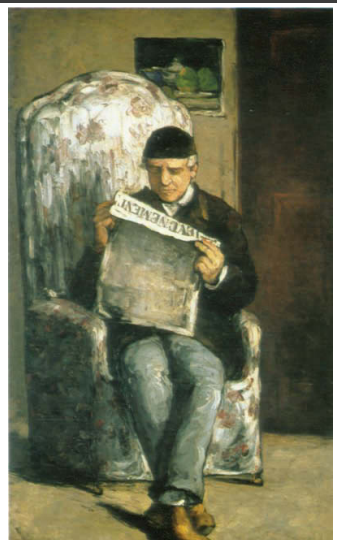
Paul Cezanne
The Artist’s Father, 1866
Oil on canvas, 198.5 x119.3mcm
(/SVs x 47 in.)
Washington, D.C., National
Gallery of Art, Collection
of Mr. and Mrs. Paul Mellon
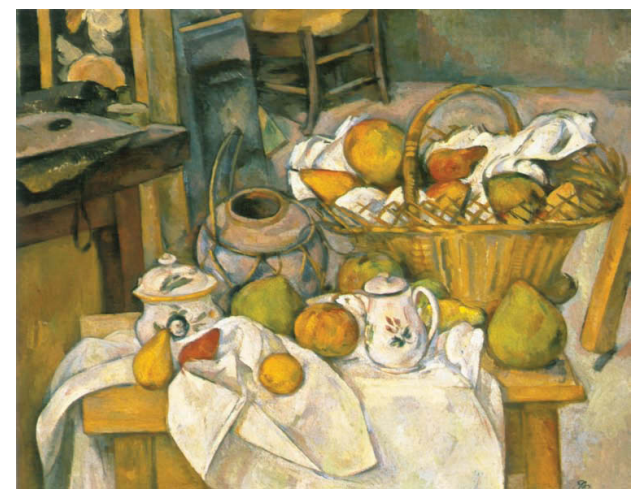
Paul Cezanne
Stili Life with Basket; or,
The Kitchen Table, 1888-90
Oil on canvas, 65 x 80 cm
(25 5/8 x 31 1/2in.)
Paris, Musee d’Orsay
R.F. 2819
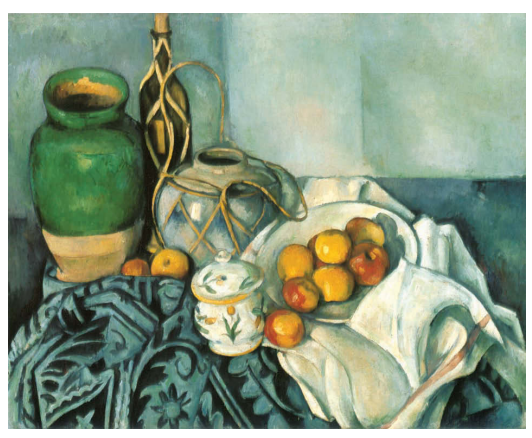
Paul Cezanne
Still Life with Apples, 1893-94
Oil on canvas, 65.4 x 81.6 cm
(253/4 x 321/s in.)
Los Angeles,
J. Paul Getty Museum 96.PA.
How Cezanne’s Still Life Paintings Are Self-Portraits–A Biography
“… [Cezanne] was most identified with a single local landscape, that of and around Aix-en Provence; and was least attached to the movable feast and touristic world of Paris and its suburbs and their transient population and lifestyle. Born (out of w edlock) in Aix in 1839 to a hatter and his mistress and soon-to-be-wife (Louis-Auguste Cezanne and Anne Elizabeth Honorine Aubert, a native of Aix), Cezanne grew up, went to public school and then lycee, befriended the Aixois Emile Zola and Henri Gasquet, enrolled in the Ecole Gratuite de Dessin (free school of drawing), and went to law school at his father’s insistence, all in the good provincial town of Aix-en-Provence. (By that time his father had become a banker and property owner, a bon bourgeois of Aix.) Cezanne first left Aix for Paris in 1861, at Zola’s urging. Thereafter, he went back and forth between Paris and Aix, first returning to Aix in September of 1861 six months after having left for Paris, to do a stint in his father’s bank. He returned to Paris a little over a year later, in November of 1862, and remained until July of 1864. He was back in Paris the next year, only to return to Aix in the winter. The year 1866 saw him returning to Paris and then to Aix again, and then back to Paris. It went on like this, with sojourns in Auvers and Pontoise and other places and longer periods of residence in L’Estaque, on the bay of Marseilles, through the seventies —including the siege of Paris, during which he dodged the draft, and the Commune of 1870-71—and into the eighties, though Cezanne’s stays in Aix and L’Estaque grew longer and longer and his intervals in Paris shorter and shorter. By the time his father died, in December of 1886, and the family’s Jas de Bouffan property on the western outskirts of Aix was bequeathed to his children (Paul, Marie, and Rose Honorine —the two sisters were two and fifteen years younger than Paul, respectively), Cezanne had resettled in Aix, although he continued to make trips to Paris and elsewhere.
“By the nineties and the rise of Cezanne’s fame, painters were making pilgrimages to Aix to see him, and from then until the end of his life, in 1906, he was the hermit painter and master of Aix.
“Cezanne himself remarked on his ties to Aix, “When I was in Aix, it seemed
to me that I would be better elsewhere; now when I’m elsewhere I miss Aix.”7
Many a provincial boy with high ambitions must have felt similar ambivalence, but in Cezanne’s case there was a particular Aixois flavor to the love/hate feeling about his provincial birthplace: while in one breath he complained bitterly of the “steppe of the good city of Aix” and its provincial population, in the next he said, “I wouldn’t be here if it weren’t for the fact that I love the configuration of my countryside so deeply.”8 …
“I was born there, and it is there that I will die. Today everything in reality changes, but not for me, I live in the town of my childhood, and it’s under the eyes of people of my own age and place that I revisit the past.”10 And indeed it was in Aix that he was born and in Aix that he died.
“Although it was the landscape of Aix for which Cezanne expressed his yearning, the Aixois feeling permeates his still lifes at least as much as his landscapes: not only by looking a bit like landscapes, some of them (we will have occasion to return to this theme with regard to Still Life with Blue Pot), but also in the ways that I have enumerated—the pots and glassware, the fabrics, the rough-hewn furnishings, the palette. Even his “handwriting” had an Aixois feel to it: from the crude couillarde facture of the early years to the distensions and crookednesses and even the tilt and pitch of space and brush stroke of the later years. One thinks of these things as Cezanne’s personal peculiarities—and indeed they were—but experience of the geological and vegetal growth patterns of the Provencal countryside begins to corroborate the Aixois inflection of those peculiarities and the importance of Cezanne’s immersion in Aix. There was, in short, a kind of Provencal accent to Cezanne’s still lifes as much as to his landscapes. And that accent was one that Cezanne cultivated in life as well as in art, nowhere more so
“Of course Paris was important to Cezanne: its artistic society, its exhibition
culture, and its museums, not to mention the contrast it provided to Aix, the impetus to return there that it gave him, and the reinforcement of his outsider status that it furnished. Indeed it intensified his identification with Aix and Provence. In Paris he attended the Academic Suisse (the Parisian free school of drawing where so many of the new generation of painters met), where he met other Aixois refugees (such as the dwarf painter Achille Emperaire, whom he painted at the end of the sixties) as well as other outsiders, such as Camille Pissarro.
” (Meanwhile he also reenrolled in the Ecole Gratuite de Dessin in Aix. Unlike others of the Impressionists-to-be, he never enrolled in an academic studio in Paris.) There in Paris he attended Zola’s Thursday evening soirees, visited Manet’s studio, copied in the Louvre, submitted paintings to the annual Salons, and was rejected with a consistency that exceeded the experience of all of the other “new painters.”11
“There he got his paints from Pere Tanguy and others and eventually began to sell paintings and watercolors to Victor Chocquet (see pi. 20) and other interested parties. There he went to the Cafe Guerbois and later the Nouvelle-Athenes to discuss the “new painting” and other subjects with Manet, Edgar Degas, Claude Monet, and others, and it was there that Monet recalled that Cezanne “pushed his jacket aside with a movement of the hips worthy of a zincworker, pulled up his pants, and openly readjusted the red belt to the side. After that he shook everyone’s hand. But in Manet’s presence he removed his hat and smiling,
said through his nose: ‘I won’t give you my hand, Monsieur Manet, I haven’twashed
for eight days.'”12
“And there in Paris the “curious Provencal,” as Pissarro called him,13
joined the Impressionist group for its first exhibitions, contributing three works to the inaugural exhibition of 1874 (one of which was A Modern Olympia, Cezanne’s caricatural response to Manet’s famous painting), and sixteen works to the third exhibition, in 1877, including some watercolors and still lifes (pi. 20), some bathers, and above all landscapes. Although he bowed out of the second show, in 1876, and after 1877 never again participated in the exhibitions himself, he remained tied to the group that became known as the Impressionists. Later, after becoming for a while the “forgotten painter” of the new art,14 it was in Paris that he began to be recognized by critics, younger artists, and the dealer Ambroise Vollard, who gave him his first solo exhibition in Paris in 1895 (while Cezanne himself remained in Aix). It was finally in Paris that a room at the Salon d’Automne was devoted to Cezanne’s work in 1904; in Paris that another ten paintings were exhibited in the Salon d’Automne of the next year, with a show of watercolors up at Vollard’s earlier the same year (1905); and in Paris that there were two rooms full of Cezanne’s paintings, again at the Salon d’Automne,in 1907, the year after his death in Aix.
“It was also in Paris that the other side of Cezanne’s life began to take shape:
a private life so private that it was for a long while a secret—a private life, moreover,that was eventually separate from his painting life, as private as that was too. For it was in Paris, in 1869, that Cezanne first met the Jura-born model and seamstress Emelie Hortense Piquet, who became first his mistress; then the mother of his only son, Paul, born out of wedlock in 1872; and finally his wife in 1886, just before the death of his father that year. This was in some ways a repetition of his own parents’ story, as they too did not marry until after Cezanne’s birth. In other ways it was a tremendous source of anxiety for Cezanne, who, requiring his father’s support and already worried about his disapproval, was forced to keep the relationship with Hortense hidden from his family. Indeed he went to great lengths to do so; part of the reason for his choice of L’Estaque rather than Aix on many of his southern sojourns was to keep his father unaware of Hortense’s existence. (His father, having been elected to the city council of Aix in 1870, was all the more conscious of his good bourgeois reputation and undoubtedly all the more desirous of forgetting aspects of his own earlier life with Cezanne’s mother.) The threesome lived together in Auvers in 1873, but more often Hortense and then Paul as well were hidden in L’Estaque,while Cezanne journeyed from there to visit his family at Jas de Bouffan in Aix.Sometimes they were sequestered in Marseilles; sometimes they were stowed away in Paris. Hortense herself chose to live apart from Cezanne in Paris.
Cezanne wrote to his mother about the birth of his son, Paul, in 1872 but with
her help kept it a secret from his father. Rather than go to his father for additional money to support his family, he sought help from Zola, who had become a respectable married man himself in 1870, the year after Cezanne met Hortense.
Meanwhile Cezanne continued to communicate with his mother, but not his father, about Hortense and Paul. In 1878, however, his father began to read his letters and suspect that something was up. First Louis-Auguste threatened to cut off his son’s allowance, but then he seemed to come to terms with the fact of his son’s menage.
Ultimately both of Cezanne’s parents attended the marriage ceremony in 1886 that legitimized Paul and regularized Cezanne’s personal life. It was this “sentimental journey” that Zola immortalized so luridly in The Masterpiece of 1886, the famous story of a failed modern artist and his irregular household, which blended Cezanne’s life story with those of Manet and Monet and gave it a tragic ending that was contradicted, perhaps deliberately, by Cezanne’s neatening of his domestic arrangement later that year. But so clearly did the novel lean on Zola’s knowledge of Cezanne’s situation, his awareness of Cezanne’s notorious uneasiness around women and anxieties about the female model (awkward and anxious, he alternated between intense fear of physical contact and sudden submission to fierce and clumsy desires where women were concerned), and his feelings about Cezanne’s art, that it resulted in a permanent parting of ways between the two old Aixois friends.15
The marriage of Cezanne and Hortense, the death of his father, the availability of the property of Jas de Bouffan to the painter and his friends (Pierre-Auguste Renoir came to visit him there): this confluence of events settled Cezanne’s life in Aix. But, curiously, it did not end the seclusion of Hortense and Paul or the segregation of Cezanne’s painting from his private life. Indeed, for all intents and purposes,
it would appear that the Cezanne marriage increasingly became a kind of inconvenient marriage of convenience. Vincent van Gogh described it enviously as a “middle class marriage” that allowed him to get a “hard-on” in his work rather than in real-life “debauchery.”16
Although Cezanne was scrupulous about his responsibility to Hortense and Paul, they continued to live apart from him, going to Paris while he went back to Aix after an unsatisfactory family trip to Switzerland in 1890; after that
he had to force them to return to Aix, but when they did so, they lived in an apartment while he lived with his mother at }as de Bouffan. There was trouble between Cezanne mere and Cezanne’s wife; that was part of the reason why the couple so often lived apart. At the same time it is clear that Cezanne and Hortense, both extremely difficult people by all accounts — Cezanne all but schizophrenic and Hortense apparently dull, recalcitrant, and unpleasant—were more or less estranged from fairly early on, although Cezanne continued obsessively to paint the woman his friends disparagingly called “la boule,” and she repeatedly sat still to be painted.17
As for his son, Paul, Cezanne called him “the brat” when he was a child but clearly felt growing affection for him as he grew to manhood.
After the 1890 trip the family sometimes traveled together but were more
often than not to be found in separate places, even when they were all in Aix, and especially as Paul grew up and Cezanne began constructing studios for himself apart from his domicile—the first in 1900, the second and final one at Les Lauves, on the northern outskirts of Aix, which he bought in 1901 and whose construction was completed the following year (fig. 9). Although the latter was owned in common by Cezanne and his wife, it became a home away from home for Cezanne, and after his death it passed, along with his inheritance, to Paul, not to Hortense, who gave up her share of it. Meanwhile, when Hortense fell sick, Cezanne instructed his son to take care of her; when he himself became ill, he was cared for first by a housekeeper and then by his gardener, and indeed on October 22, 1906, Hortense and Paul arrived at the Les Lauves studio too late to be with Cezanne as he died. In short, even after his marriage, Cezanne continued to live apart from his household and increasingly lived his painting apart from his private life.
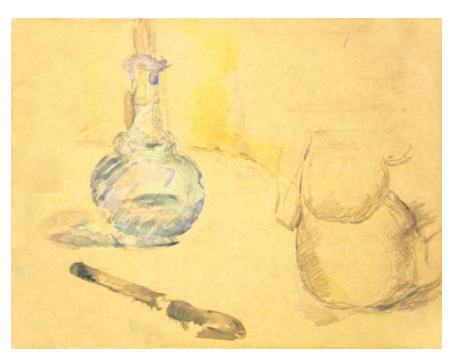
Paul Cezanne
Carafe and Knife (recto),
€.1882
Watercolor and graphite on paper
21.9 x 27.3 cm
(85/s x io3/4 in.)
Philadelphia, Philadelphia
Museum of Art,
A. E. Gallatin Collection,
1952-61-11
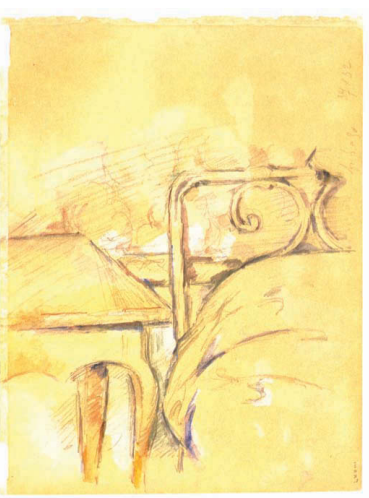
Paul Cezanne
Bed and Table (verso),
c. 1882
Watercolor and graphite
on paper, 27.3 x 21.9 cm
(io3
/4 x 85
/8 in.)
Philadelphia, Philadelphia
Museum of Art,
A. E. Gallatin Collection,
1952-61-11
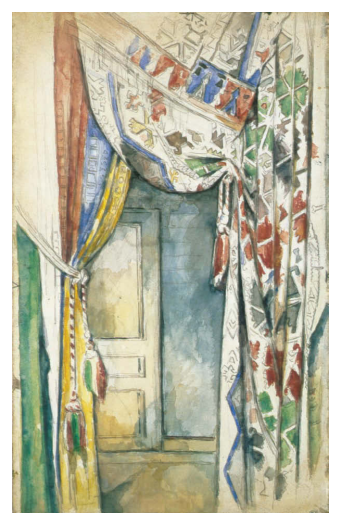
Paul Cezanne
Curtains, 1885
Watercolor, gouache,
and graphite on
white paper
49 x 307 cm (19 x 12 in.)
Paris, Louvre Museum, Orsay Fund
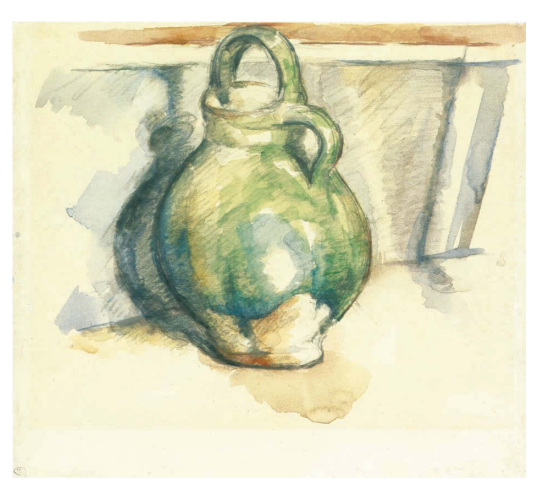
Paul Cezanne
The Green Pot, 1885-87
Watercolor and graphite
on paper, 22 x 24.7 cm
(8
11
/i6 x 93
/4 in.)
Paris, Musee du Louvre
“This famous watercolor from the mid-i880s of a little green-glazed Provencal jug suggests some of the anthropomorphism, in this case a kind of human bravado, that animates even Cezanne’s most modest still-life subjects. Its roundness and the configuration of its two handles suggest a complacent little figure, Its roundness and the configuration of its two handles suggest a complacent little figure, with belly outthrust and arm akimbo, standing singularly against the studio wall for all the world like a human model. Further, it represents Cezanne’s earlier, more traditional method of penciling and modeling an object and then filling out its volume in watercolor. p. 34
Paul Cezanne
Jacket on a Chair, 1890-92
Watercolor and graphite
on paper, 47.5 x 30.5 cm
(i811/ie x 12 in.)
Private collection
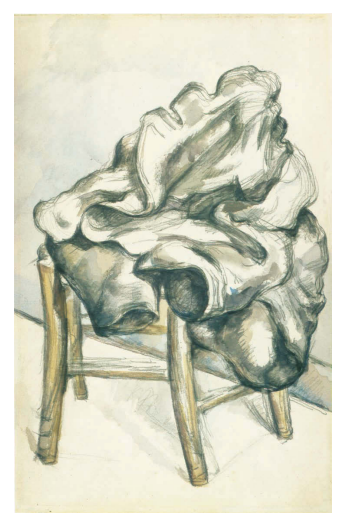
“With its empty, crumpled garment, Jacket on a Chair is even more blatant in
suggesting human inhabitation by dint of its very absence than Cezanne’s sketches of empty chairs. At the same time it situates that uncanny effect of human presence-in-absence in the studio, as a studio exercise. It consists mostly of reiterated pencil line and shading, supplemented and colored in with faint washes of watercolor.
Paul Cezanne
Still Life with Apples,
Pears, and a Pot, 1900-1904
Watercolor and graphite
on white paper, 28.1 x
47.8 cm (11 x 183A in.)
Paris, Musee du Louvre,
Fonds Orsay
human presence-in-absence in the studio
“…as a studio exercise. In short, watercolor
sketches had long been the site of experimentation with still life’s possibilities of biographical intimation.
It was in the late watercolor still lifes, however, that Cezanne made full-blown
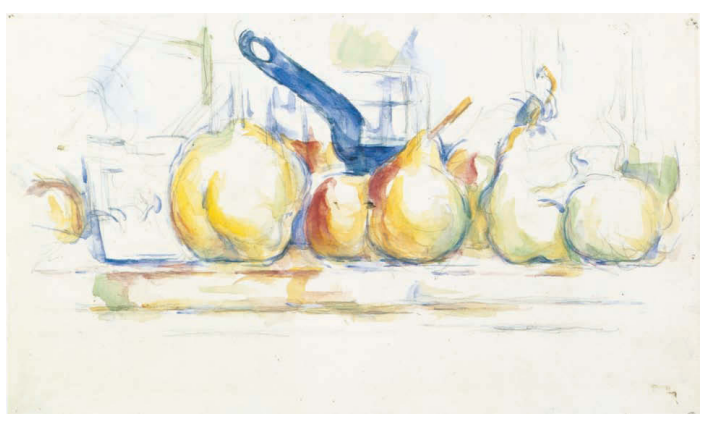
pictures out of such experimentation. There is, for instance, a watercolor of 1900-1904 that inserts the black handle of a humdrum cooking pot disconcertingly into an eye-level shelf of fruit whose row of blood-ripened, buttocklike roundnesses thoroughly justifies Meyer Schapiro’s claims for the sexuality of Cezanne’s fruit (fig. 15).
Does that pot handle truly speak of the kitchen anymore? It does so only to index its removal from the kitchen and the transformation of its function from cooking utensil to studio prop and from there to bodily and sexual displacement: never was a pot handle atop a couple of pears so preposterously phallic, and never was the row of fruit in the midst of which it erects itself so fleshy, so cleft, so bloody, and so luscious. Never, that is to say, were the “apples [pears] of Cezanne” so overtly sexual, so exaggeratedly corporeal, as in this kitchen-table-which-is-not-a-kitchen-table. The same pot, by the way, sits more unobtrusively next to a cleft, red-slashed watermelon and projecting knife handle in another watercolor of the same period (pi. 6). There it is the watermelon that is sexualized, becoming, as Rainer Maria Rilke would describe the livid mouth of a vaginal conch in a more famous still life by Cezanne, a “smooth red orifice” whose “inward carmine bulg[es] out into brightness.”21
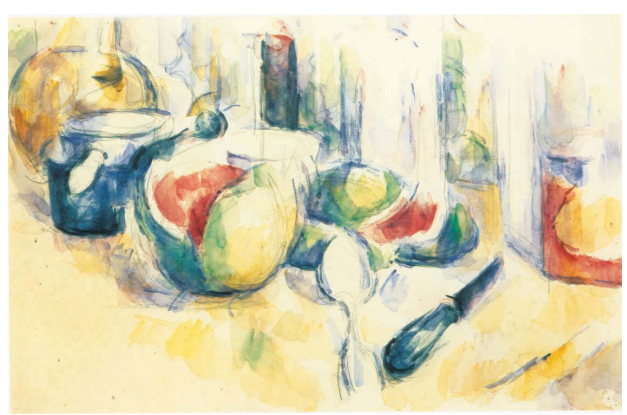
Plate 6
Paul Cezanne
Still Life with Cut Watermelon
c. 1900
Watercolor and
graphite on white paper,
31.5 x 47.5 cm
(i25
/8 x i83
/4in.)
Riehen/Basel,
Fondation Beyeler 78.1
“A kitchen pot sits unobtrusively next to a cleft, red-slashed watermelon and projecting knife handle in this late watercolor. Here the watermelon is sexualized, becoming, as Rainer Maria Rilke would describe the livid mouth
of a vaginal conch in a more famous still life by Cezanne, a “smooth red orifice” whose “inward carmine bulg[es] out into brightness.” Both this and the Louvre St/7/ Life with Apples, Pears, and a Pot (fig. 15) suggest the much more open ended relation between pencil contouring and the pigmented liquidity of watercolor, as well as the more indeterminate position of the study between sketch and tableau, which characterizes Cezanne’s late works in watercolor. “kitchen tables” leave the kitchen behind to assert the context of the studio as the space of art and its ability to make things into bodies, at the same time they point to the kitchen offstage—and to the space of the house beyond—by its very absence, always marking its possible though invisible contiguity with the realm of the studio. And, paradoxically, they do so more insistently than any other still-life oeuvre that I can think of.
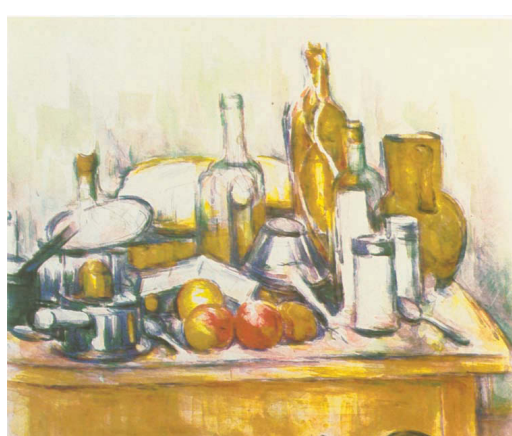
Figure 16
Paul Cezanne
Bottles, Pot, Alcohol
Stove, and Apples,
c. 1900-1906
Watercolor and graphite
on paper, 47 x 56 cm
(i8
1
/z x 22 in.)
Private collection
There is, for instance, from the same period (1900-1906), the table overflowing with kitchen items, obviously removed from the kitchen to make a studio still life, but nevertheless suggesting the kitchen to such a point of excess and overload that overdetermination and obsession rear their heads (fig. 16). The kitchen is simultaneously everywhere and nowhere in the atelier; it is colonized by the atelier, and it is the atelier’s other. Indeed, this “kitchen table” is so chock full of kitchen implements—bottles, pitchers, pots, burners, sugar casters, and of course fruit—that it gives new meaning to the expression “everything but the kitchen sink.” Yet they look like such objects look on moving day, gathered together in surplus, not in use, as if for an inventory of all the kitchen items that had been stolen for studio purposes.
Thus this kitchen table too, in its very excess of kitchenness, marks the replacement of the kitchen by the studio.
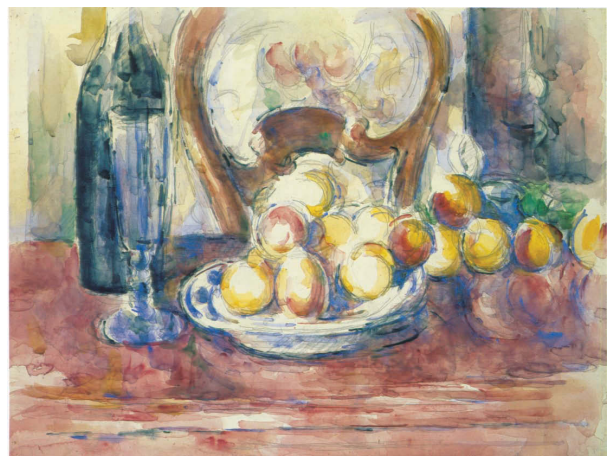
Paul Cezanne
Still Life with Apples and
Chair Back, c. 1904-6
Watercolor and graphite
on white paper, 44.5 x
59 cm (i/Vz x 2314 in.)
London, Courtauld
Institute of Art Gallery,
The Samuel Courtauld Trust,
D.1948.SC.H1
This baroque still life returns to the empty chair back of earlier sketches and sets it behind a richly colored table full of fruit, a bottle, and an empty glass, suggesting with uncharacteristic directness the scene of dining that is still life’s traditional fare but remarkably absent from the rest of Cezanne’s still-life oeuvre. The studio has suddenly become festive, like a pared-down banquet left over from Cezanne’s wild early years, when he painted orgiastic banquets. It is as if someone has finally been invited for dinner or dessert in the studio and even been offered a seat at table rather more elegant than the studio’s usual rustic chairs. And yet, poignantly, there
is nobody there after all. As loosely rendered as it is, this is a richly complete wat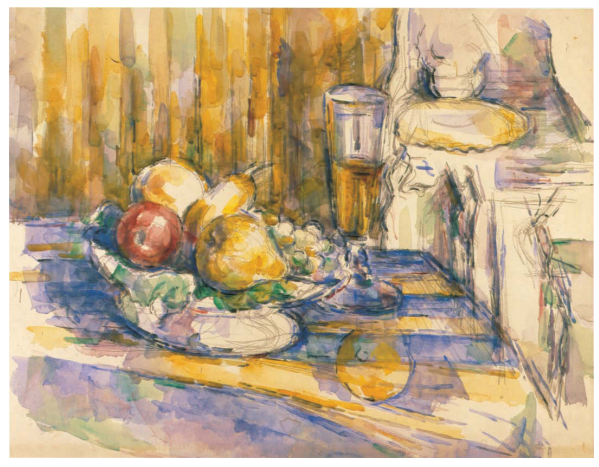
Paul Cezanne
The Dessert, 1900-1906
Watercolor and
graphite on white paper,
47 x 61 cm
(iSVz x 24 in.)
Private collection
“In The Dessert, a late, exceptional still life in watercolors, the space that is so often implied beyond the frame of Cezanne’s still lifes is actually glimpsed around the corner of a wall and the far edge of the expansive table, with its compotier and flute glass, the same one that sits waiting in Still Life with Apples and Chair Back (pi. 7). That space might be the kitchen or a surface in the studio improvised for food preparation and presentation. In among the hasty, partial indications of things to be fleshed out later—a piece of fruit on the table? the edge of a curtain? the edge of another counter surface?—there is the hallucination of a sort of profile: a bit of a nose and nostril, an eye, even an ear (just to the right of the curtain of watercolor and beneath the beginnings of the wavy-lipped plate). A figment of the studio imagination, this
spectral profile signals the watercolor’s stateof incompletion and its experimental thinking, not to mention the human absences that animate it.
And then there is the baroque still life of 1904-6 that returns to the empty
chair back of other earlier sketches and sets it behind a richly colored table full of fruit, a bottle, and an empty glass, for the first time suggesting the scene of dining, which is still life’s traditional fare but remarkably absent from the rest of Cezanne’s still-life oeuvre (pi. 7). The studio has suddenly become festive, like a pared-down
banquet left over from Cezanne’s wild early years, just before he met Hortense.22
It is as if someone—Hortense? Paul?—has finally been invited for dinner or dessert in the studio and even been offered a seat at table rather more elegant than the studio’s usual rustic chairs. And yet there is nobody there after all.
In one other late, and even more exceptional, still life in watercolors, The
Dessert (pi. 8), the space that is so often implied beyond the frame is actually
glimpsed around the corner of a wall and the far edge of the expansive table, with its compotier of edible offerings—pears and grapes and perhaps apples or oranges —and its half-empty (half-full) flute glass, the same one that sits w aiting in the still life just described. That space has a quickly sketched-in countertop, wavy-edged plate, and some other vessel just begun: it might be the kitchen or a surface in the studio improvised for food preparation and presentation. In among the hasty, partial indications of things to be fleshed out later—a piece of fruit on the table? the edge of a curtain? the edge of another counter surface?—there is the hallucination of a sort o fprofile: a bit of a nose and nostril, an eye, even an ear (just to the right of the curtain
of watercolor and beneath the beginnings of the wavy-lipped plate). A self-portrait?
A watcher, waiting for inhabitation? For guests to arrive? For the picture to be
finished? Or is it nobody and nothing at all—just a figment of the studio imagination, of the pentimenti that are part of a wildly unfinished process, signaling its own state of incompletion and experimental thinking, the unlikelihood of really taking up this subject, its distance from the fullness of a picture like the Getty Still Life with Blue Pot? And of course it is a signature specter of absence in the studio—of all thebiographical absences that hover there.
From the earliest moment of Cezanne’s still-life practice there had been a
connection between still life and biography. But from that moment to the period of
Still Life with Blue Pot, the biographical aspect of still life, its studio space and its
objects, had become more and more elusive as Cezanne withdrew from the family as defined by his father and entered into his life of first secret and then separate non cohabitation with Hortense and their son, Paul. In their different ways these exceptional late watercolors sign the spectral, off-frame, displaced aspect of the studio’s intimations of intimacy, animacy, and domestic life.
++++++++++++++++++++++++++++++++++++++++++++++++++++++++++
Also check out the Catalogue of Cezanne’s work: https://www.cezannecatalogue.com/catalogue/
Discover more from Jacki Kellum
Subscribe to get the latest posts sent to your email.