“My name is Georgia Payne, and I am a quilter. I’ve been quilting since I was very young,
but only started quilting in earnest probably in the last 10 years.
….my presentation today is based on a book called “Hidden in Plain View.”
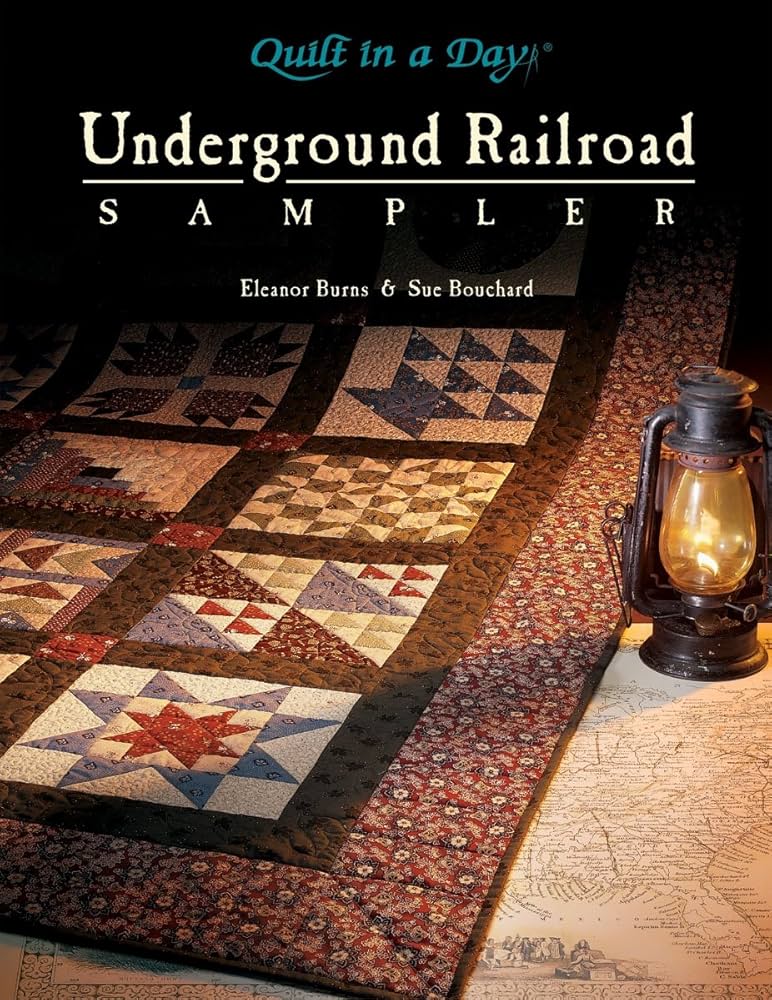
It’s a story of quilts and the Underground Railroad. The book is by Jacqueline Tobin and Raymond Dobard.
“The book is based on a story that was told to Jacqueline by Ozella McDaniel Williams,
and it’s a story that she says was passed down in her family from generation to generation. …
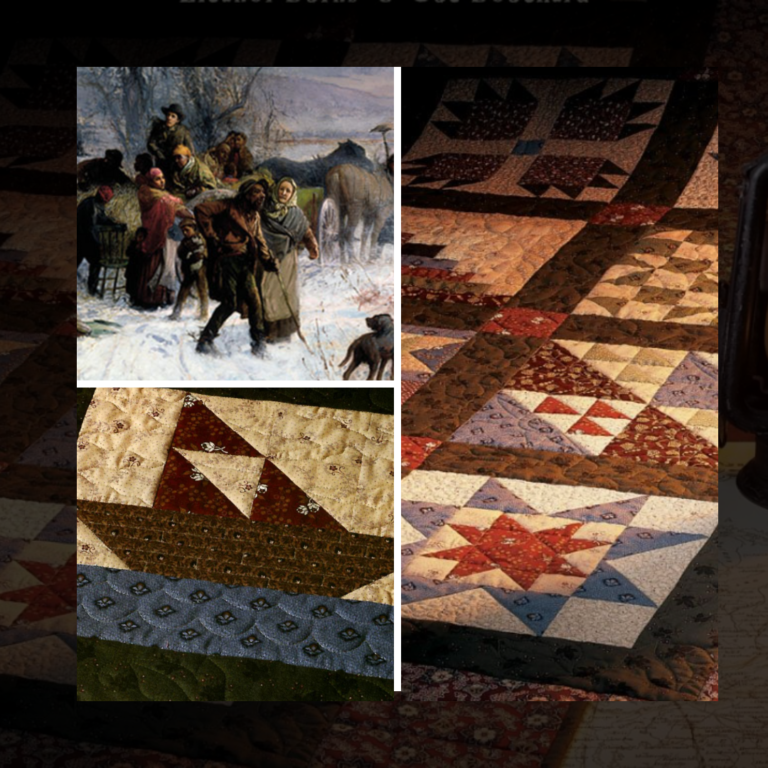
“This is just some things that I learned as I was creating the quilt that’s behind me.
“It was said by an Ohio artist, Willis Bing Davis, that slaves were not brought to America, Africans were brought to America, and there they were enslaved. So most Indigenous cultures have oral traditions, and when Africans arrived on this continent, their oral traditions came with them.
“Since it was illegal to teach slaves to read and write, stories, secret codes, words, and songs were often used to communicate secret messages. So just because it wasn’t documented or it wasn’t written down doesn’t mean that it didn’t happen, and it doesn’t mean that it’s not history.
“So according to Ms. Williams’ story, there were 10 major quilt patterns that were used,and there were a number of secondary patterns that were used also.
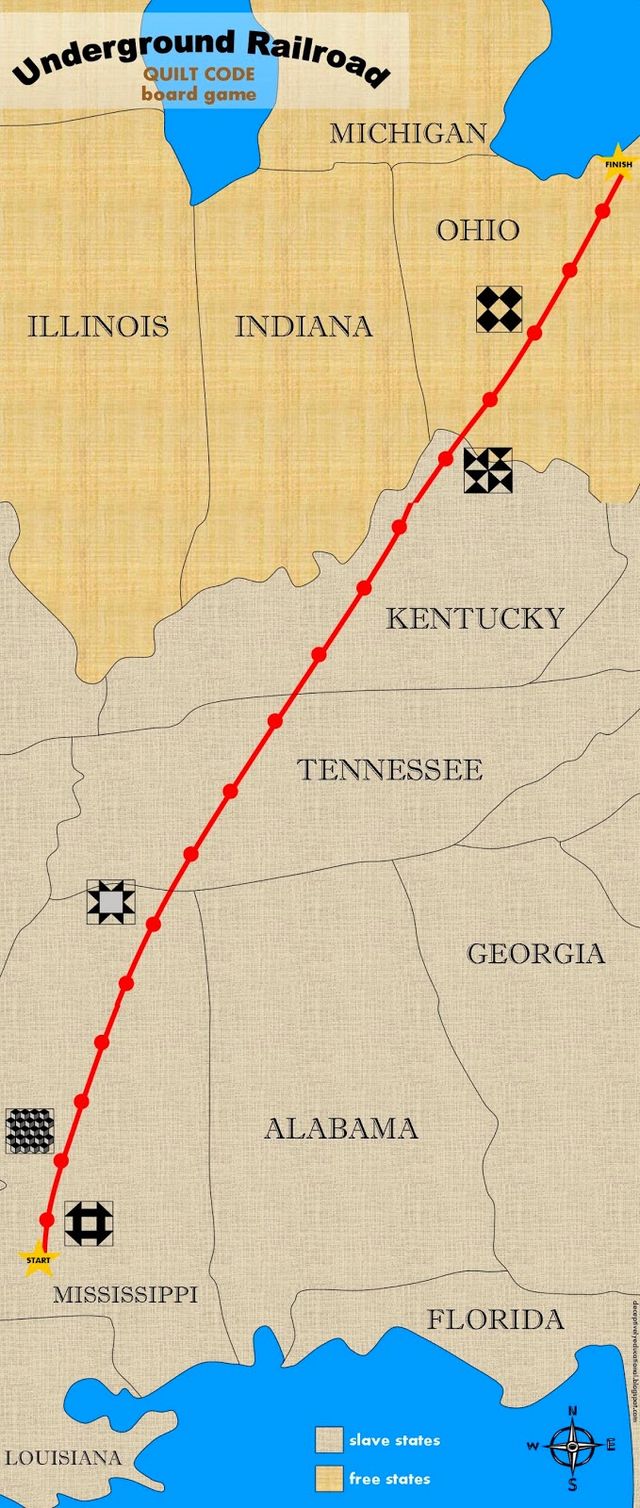
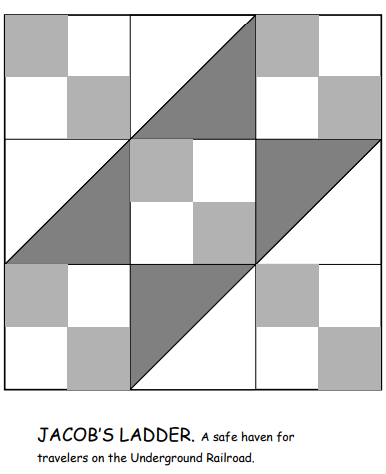
The quilt code is remembered this way.
“The monkey wrench turns the wagon wheel towards Canada
on a bear paw’s trail to the crossroads. Once they got to the crossroads, they dug a log cabin on the ground. Shoofly told them to dress up in cotton and satin bow ties, go to the cathedral church, get married,and exchange double wedding rings. Flying geese stay on the drunkard’s path and follow the stars.
“So if you’re a quilter, you may recognize the names of these quilt patterns.
“These were 10 patterns that were used to direct slaves to take a particular action.
“Each quilt featured one of the 10 patterns. The quilts would be placed on a plantation fence or a clothes line, one at a time by house slaves. It’s not known exactly how long each quilt would hang, but it was hung out long enough for everyone to see that the quilt was out and get the message and pass it on.
“And since it was common for quilts to be aired outside, the master or the mistress would not be suspicious seeing the quilts hanging on the line. Each quilt, though, was a message and signaled a specific action for the slave to take or to consider while the quilt was in view.
“These quilt messages would be remembered to use later on on their journey. The quilt codes had dual meanings, both to prepare to escape and also to give clueor to indicate directions on the journey. And some of it was a mental preparation too. not just a physical preparation. …
“The Underground Railroad got its name based on a story of a Kentucky slave known Tice. He was being tracked by a slave holder, and when Tice got to the Ohio River, there was no boat waiting for him so he jumped into the icy water and began to swim, And the story goes that he heard the sound of a bell or a call of a bird indicating someone on the other side . was waiting for him.
“It is said that the slave holder took his eyes off of Tice for just a second, and he vanished.
“When the slave holder went back home empty handed, he told everyone it was as if the slave had disappeared on some kind of underground railroad. The name stuck, and the journey of slaves escaping to the North has been called this ever since.
“The most famous conductor of the Underground Railroad was Harriet Tubman, a former slave. It is said that she made 19 trips north with runaways and led more than 300 people to freedom. She became known as Moses to her people.
“Also, the singing and the humming of certain spirituals was often done while displaying these special quilts. Singing was another way that messages were shared and communicated to other plantations. So the code begins with the first block out of the ten.
It’s called the monkey wrench, and it’s the one with the squares that’s next to the Underground Railroad block.
So the story goes, the monkey wrench turns the wagon wheel towards Canada.
A monkey wrench is a heavy metal tool used by the blacksmith,
and the blacksmith was one of the most knowledgeable persons on the plantation,
and he was also known as the monkey wrench. He might be loaned out to neighboring plantations,
so he knew the lay of the land, and he was often the one to get things started.
So when this monkey wrench quilt was hung out, slaves were to start gathering all of the tools
that they might need on their journey to freedom. The song “Let Us Break Bread Together On Our Knees”
is telling others that the quilt is out, or there’s going to be a secret meeting.
So information about the quilt being on display was also being passed through song
from plantation to plantation, or when slaves would see each other on the road or in town.
The next block in the Underground Railroad code is the wagon wheel, and that’s the circular one.
This pattern, when this quilt was hung out, signaled the slaves to pack their essential things
and provisions for survival as if they were packing a wagon. And also to consider the limited space and the weight.
Wagons were built with hidden compartments and used to transport escaping slaves.
It also is symbolic of a chariot that was to carry them home.
In the fields, slaves may have sung the song “Swing Low Sweet Chariot, Coming to Carry Me Home,”
as these songs contained hidden messages. One of the secondary codes,
not one of the 10 major codes, but one of the secondary codes was the carpenter’s wheel.
So with help from Jesus, the carpenter, and that’s the one with the stars.
I don’t know if you can see all of it. The stars in right corner there.
To the slave, the master carpenter in their lives was Jesus.
This is a secondary code and pattern, and it was also used as a directive to help them plan their escape.
They were to follow the carpenter’s wheel to the west-northwest.
Many spirituals instructed the listener to steal away to Jesus, to run to Jesus,
meaning follow the carpenter’s wheel to the west-northwest. Plantation owners thought
they were just talking about heaven or singing about heaven. And it is also believed that most of the journeys
began in the springtime when it would be heavy rains, and that aided the slaves in their journey
and from being detected. The lyrics in the song “Steal Away” says,
“My Lord calls me by the thunder,” and this told them to leave in the rainstorm
so dogs won’t have a scent to follow, and their footprints would be washed away.
So the lyrics in that song also include, “green trees bending,” referencing summer, referring to summer,
“the tombstones bursting,” meaning hiding in a graveyard, and, “the Lord, He calls me by the lightning,”
which would illuminate the landscape. And lastly, “the trumpet sounds within my soul,
I ain’t got long to stay here.” They were singing about freedom.
The third block is the bear’s paw, here.
Slaves were to follow the actual trail of a bear’s footprints,
indicating the best path through the Appalachian mountains. It would be easier to follow the tracks in the spring
when the bears were waking up from hibernation. The mountains ran parallel
to the Underground Railroad route, some of the routes. Following the bear’s paw
would also lead them to a supply of fresh fish and water.
So that was the direction from the bear’s paw. And Native Americans were also very helpful
in providing trails for them to follow. The next one of the secondary blocks
was fill your baskets, and I don’t have that one on the quilt. It’s fill your baskets with enough food and supplies
to get them through on their journey. So they were to pack a sewing basket or a laundry basket,
which would not arouse any anyone’s suspicion if they were to see you carrying it.
Feeding themselves along the way would be difficult. They couldn’t just walk into a store and buy food.
They depended on the safe houses and the abolitionists or their friends along the way.
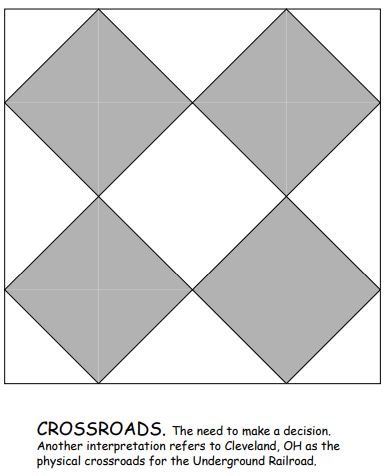
The next block is the crossroads,
this one is the basket, and this one is the crossroads. To get them to the crossroads.
So once they made it safely through the mountains, they were to go to the crossroads or a city where they would find protection and refuge.
The main crossroad was Cleveland, Ohio, which was also called Hope,
the most northern spot before they would catch the boat to Canada. Detroit, Michigan was also a crossroads.
It was called Midnight. Their fugitives could take four or five trails over land
that connected with many of the water routes in the area crossing Lake Erie into Canada.
At this crossroad, a decision needed to be made whether to continue on to Canada or to stay in Ohio,
as you may never be able to come back and see your family again.
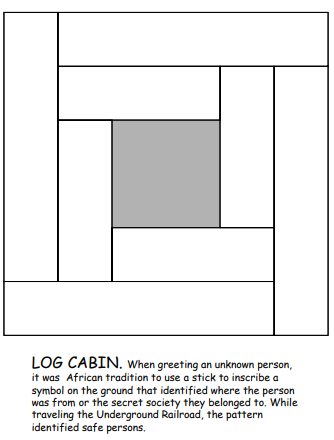
The fifth block was the log cabin block, a very familiar block to quilters.
Once they got to the crossroads, they dug a log cabin on the ground.
So it is a reference to safe houses along the way, usually a light would be hanging in the window,
that was ran by abolitionists or sympathizers. Traditionally, log cabin quilts have a red center
representing the fireplace or the hearth of the home. It is believed a log cabin quilt hanging with a black center
or a yellow center was a safe house. William Still, who was also a famous
Underground Railroad conductor in Philadelphia, had a log cabin quilt in his home with a yellow center.
And when I was talking about the monkey wrench, Frederick Douglass, it was a quilt that hung in his home
that used a monkey wrench block, a monkey wrench pattern.
The sixth pattern is called shoofly,
all the squares here. Shoofly told them, and it was believed that shoofly was an actual person,
possibly even Harriet Tubman herself or others who helped slaves to escape.
Free Blacks and members of the Prince Hall Mason Society
also assisted runaway slaves. They hid them in churches and in caves,
in cellars, in walls, any place that they could.
And graveyards even, especially if they were on the outskirts of town or near a river.
And the seventh number, block number seven or pattern number seven,
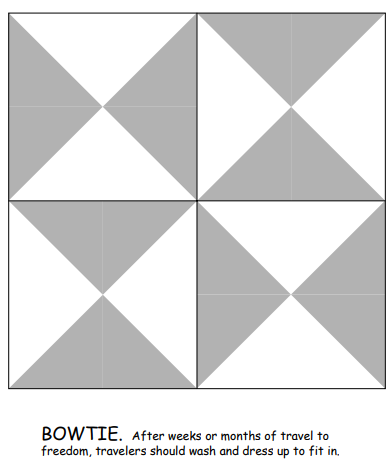
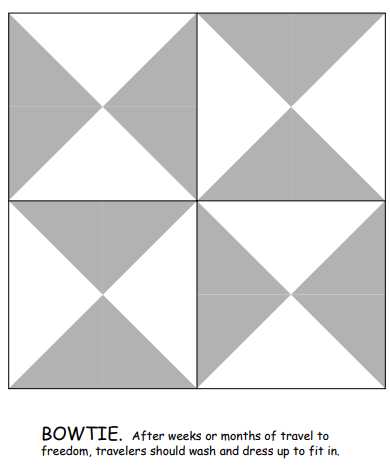
was the bow tie block. Shoofly told them to dress up in cotton and satin bows
and go to the cathedral church, get married, and exchange double wedding rings.
So the wedding ring is another quilt pattern.
But slave clothing was often worn and tattered,
old, dirty, all of those things. And it would easily give away their status
as runaway slaves. So this quit pattern was telling them to dress up,
to change clothes. Free Blacks would meet the slaves
in a safe place like a church and give them fresh clothing.
And in my research, I found too that there were a lot of sewing circles of abolitionary women and sympathizers, white sympathizers,
who provided clothes and underwear to assist runaway slaves.
And they would mail them to the safe houses and different Underground Railroad stations in the area
so that they would have fresh clothes to wear. Wearing dresses and sun bonnets and satin bows,
runaways then wouldn’t stand out among city folks, and it was easier for them then to walk through the town
to waiting ships. That sun bonnet is another pattern.
Sun bonnet Sue, if you’re a quilter, you know what that looks like, the bonnets,
like Little House kind of on the Prairie bonnets. And they had long bills on the front of them.
It was said in, I wanna say Wisconsin, but don’t quote me on that, that there was a pastor
that was an abolitionist and helped. And he would go into town with two women
wearing these sun bonnets, and he would come back. He’d still have these two women with sun bonnets,
but no one would notice that when he returned, those women had brown faces
because of the bonnets that they wore, covering their heads.
So when you look at this bow tie block, the quadrant, the quadrants, I can’t say that word,
on the bow tie block, they represent morning, midday, evening, and night.
When the block is turned on its side, it presents an hourglass shape,
meaning manage your time wisely. People are waiting to help you.
And then you can see a pinwheel shape in here,
a pinwheel. And that pinwheel shape is also a pattern
called broken dishes. It is formed in the center. And this pattern had the potential of forming a compass
or a sundial in the cloth and providing directions to the slave of which way to go.
I talked about the double wedding rings. That block is not in my quilt, but I recently learned
in a Smithsonian documentary regarding slavery that runaways would get married,
not just jumping the broom, symbolic of marriage, but they would actually get married as they were more likely to be considered free Blacks
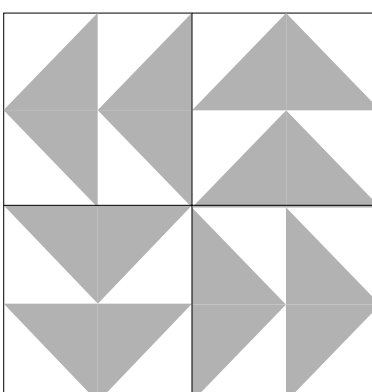
if they had a marriage certificate. Block number eight is flying geese.
Geese fly north in the spring and in the summer, and so this quilt could indicate direction
if they used different colored fabrics. It could indicate direction. And it was also the best time for slaves to escape.
Geese have to stop at waterways in order to rest and to eat. And since they make loud honking noises,
it was easy for runaway slaves to follow their flight patterns. So this block would be sewn in a counterclockwise direction,
north, west, south, east. It was another way that a quilt could indicate direction
or act as a compass, using fabric to make one of the set of keys
different from the others and provide an indication of which way to go.
The next block, birds in the air, this is a secondary block. It wasn’t one of the major blocks, it’s a secondary block,
but it was another block symbolizing flight and migration and direction
for indicating which way for the slaves to go.
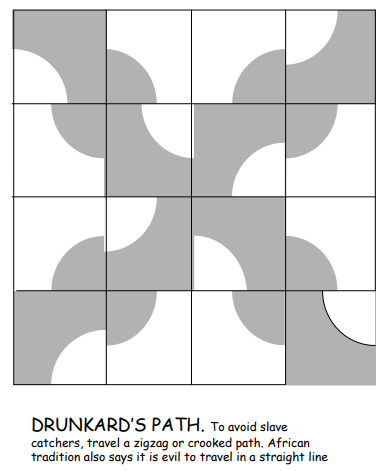
The ninth block in the codes was the drunkard’s path.
You can see that, adjust it just a little bit, part of the drunkard’s path.
Blind geese stay on the drunkard’s path. So following a drunkard’s path was a warning for slaves
to weave back and forth, never moving in a straight line.
They would even double back on their tracks to confuse slave hunters with dogs
that might be pursuing them. And I also learned that there’s a well-documented crooked line from Charleston, South Carolina
to Wheeling, West Virginia that was a major crossing place for slaves escaping to Virginia through the mountains.
The fugitive stayed on the drunkard’s path and followed the stars. And it’s said that safes houses
were also staggered in a crooked path. They weren’t always in a straight line from one to the next.
The next code is the sailboat.
Take the sailboat across the Great Lakes. The Underground Railroad used many routes,
by sea, by lake, by river, by canals.
Black sailors and white ship owners helped slaves escape,
hiding them on board their ships, passing on directions and messages from family
that was waiting for them in freedom. They were an important link in the grapevine
between slaves in the South, again, who were forbidden to read or write,
and their free counterparts in the North. The Compromise of 1850,
which was a law that strengthened the Fugitive Slave Act
and it allowed slave holders to pursue and retrieve runaway slaves in Northern states
and free territories. So runaway slaves were not safe until they actually reached Canada,
so many depended on ships and ferries to cross the Great Lakes.
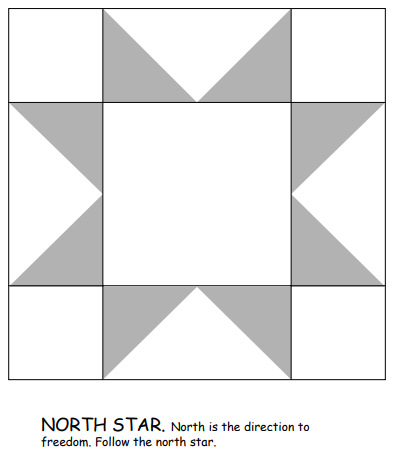
And then the 10th star, the 10th pattern, was the North Star,
and that was the last instruction, follow the star. Like the Star of Bethlehem guiding the Wise Men,
the North Star has been historically connected with the Underground Railroad.
The North Star was the guiding light leading slaves to Canada and to freedom.
The Big Dipper or the Drinking Gourd always points to the North Star in the handle of the Little Dipper.
This eight point star is also called the Evening Star, and it is honored as a guiding light for fugitive slaves.
There is no song that’s more connected to the Underground Railroad than the song called “Follow the Drinking Gourd.”
“Follow the drinking gourd.” There is another secondary pattern
that I don’t have in my quilt. It’s called tumbling blocks. It looks like baby blocks or building blocks,
and it may have been one of the last quilts that was used or one of the last quilts that was hung out.
And then when that quilt showed up, the slaves knew that it was time to escape.
It was time to go. It’s time to tumble out of your life, tumble out of your role.
The conductor is here. Are you ready to go?
So those are the codes in my quilt. And this square here is just a block or a key
that tells the story of that I read to you later about the quilt code.
The monkey wrench turns the wagon wheel and so on and so forth.
I also learned, too, many of you may be familiar with barn quilts.
It’s believed that that whole practice of painting quilt patterns onto wood
and then hanging them onto barns originated in Pennsylvania and then it spread to other colonies.
During the Revolutionary War, barn quilts were used to show American forces
that an area was safe or secure and supplies were available.
And years later during the Civil War, it is reported that the Underground Railroad
used barn quilts for the same purposes, to show safe places.
I found that very interesting. I had not heard that before. But after the Civil War, many African American women
went to work in households as domestics, while others helped out on small farms.
And quilts were made for everyday use out of necessity.
Scraps of clothing, discarded clothing, feed sacks, any kind of fabric was used to make a quilt.
String quilts were real popular, strips of fabric sewn together and then cut into blocks
and made into a quilt. So quilt making has continued in the African American community,
and today’s quilts tell stories of a struggle for achievement
and African American history makers. Story quilts and art quilts are a new category.
And there’s some amazing artists out there. While some African Americans are making stunning art quilts,
and there’s some links in your chat box of some of those, people like Bisa Butler,
many are still making quilts the old way, the same old way. And new patterns that quilters in general enjoy.
African American quilters over the last 40 years have participated in traditions established by their families and communities
while also developing new ones. Black women today are also making quilts
that reflect African culture. Makers, historians, and artists are always using quilts
to raise awareness about African American culture, and they do that in quilts.
I was blessed to attend the modern quilt conference called QuiltCon for 2023
this year in February in Atlanta, and the featured speaker was Chawne Kimber.
She is a dean of mathematics at a liberal arts college.
That’s her profession by day. But she is a renowned quilter also that quilts by hands,
and all of her quilts have a message about overcoming,
about the struggle, those kinds of things. And it was, I don’t know if it was the first time
they’d had an African American keynote speaker, but certainly one in recent years.
And the attendance by African American quilters was beyond amazing,
and I was really privileged to be one of them.
There is a move, I guess I would say, for more diversity
of African Americans being included in quilt guilds and sewing circles and those kinds of things.
We’ve always quilted, always, but we weren’t always invited to participate in the larger community, quilt community.
And we’re seeing more and more of that, I’m pleased to say.
So again, I don’t claim to be any kind of an expert on any of this,
it’s just some things that I learned along the way and I found it very interesting
and I’m happy to share it with you tonight. There’s some resources in your chat box,
and if you have questions, I’m free to answer questions that you might have.