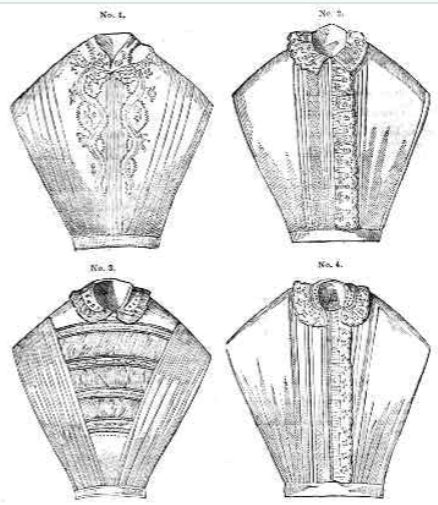
What Is A Chemisette?
“A chemisette (from French, “little chemise“) is an article of women’s clothing worn to fill in the front and neckline of any garment. Chemisettes give the appearance of a blouse or shirt worn under the outer garment without adding bulk at the waist or upper arm.
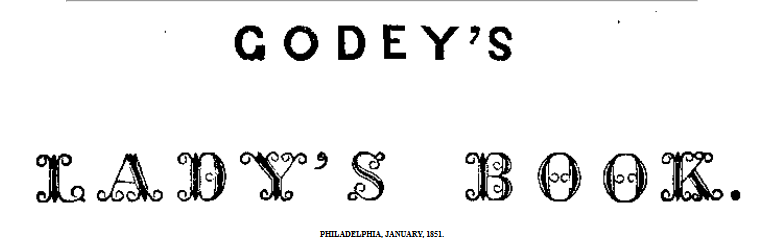
Godey’s Lady’s Book January 1851
“Chemisettes of linen or cotton were often worn with day dresses in the mid-19th century, and could be decorated with tucks, embroidery (especially whitework), or lace.
“When wide pagoda sleeves were fashionable (1850s), chemisettes might have matching engageantes (false undersleeves).” Wikipedia
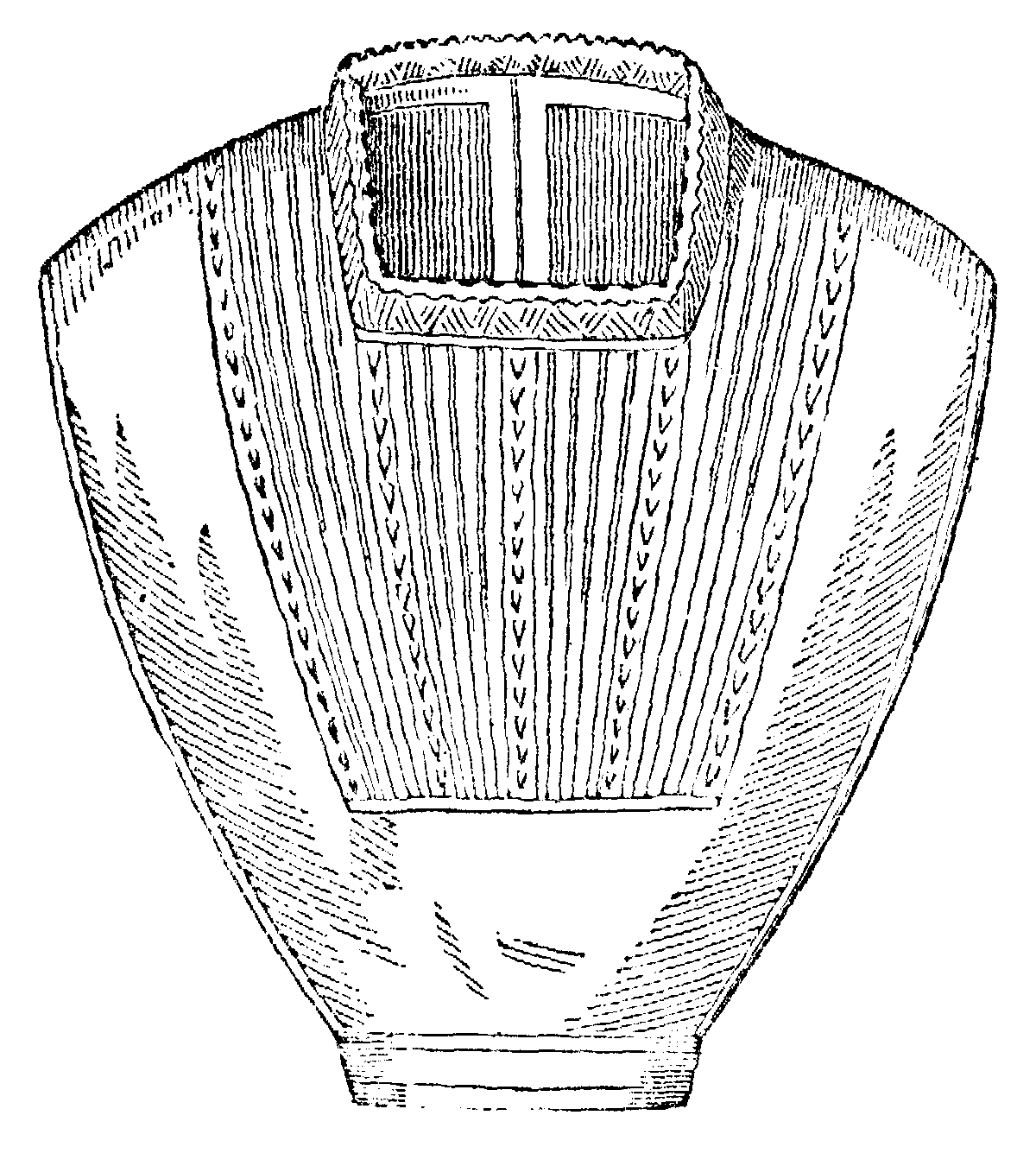
Chemisette – Godey’s Lady’s Book – January1851
“All fashionable promenade and evening dresses being cut with an open corsage and loose sleeves, the chemisettes and wristbands become of the greatest importance. There is something very neat in the close coat dress, buttoned up to the throat, and finished only by a cuff at the wrist; but it is never so elegant, after all, as the style now so much in vogue. This season, the V shape from the breast has given place to the square front, introduced from the peasant costumes of France and Italy. It will be seen in fig. 1, which is intended to be worn with that style of corsage, and corresponds to it exactly. The chemisette is composed of alternate rows of narrow plaits and insertion, and is edged with muslin embroidery to correspond. It is decidedly the prettiest and neatest one of the season, and will be found inexpensive.
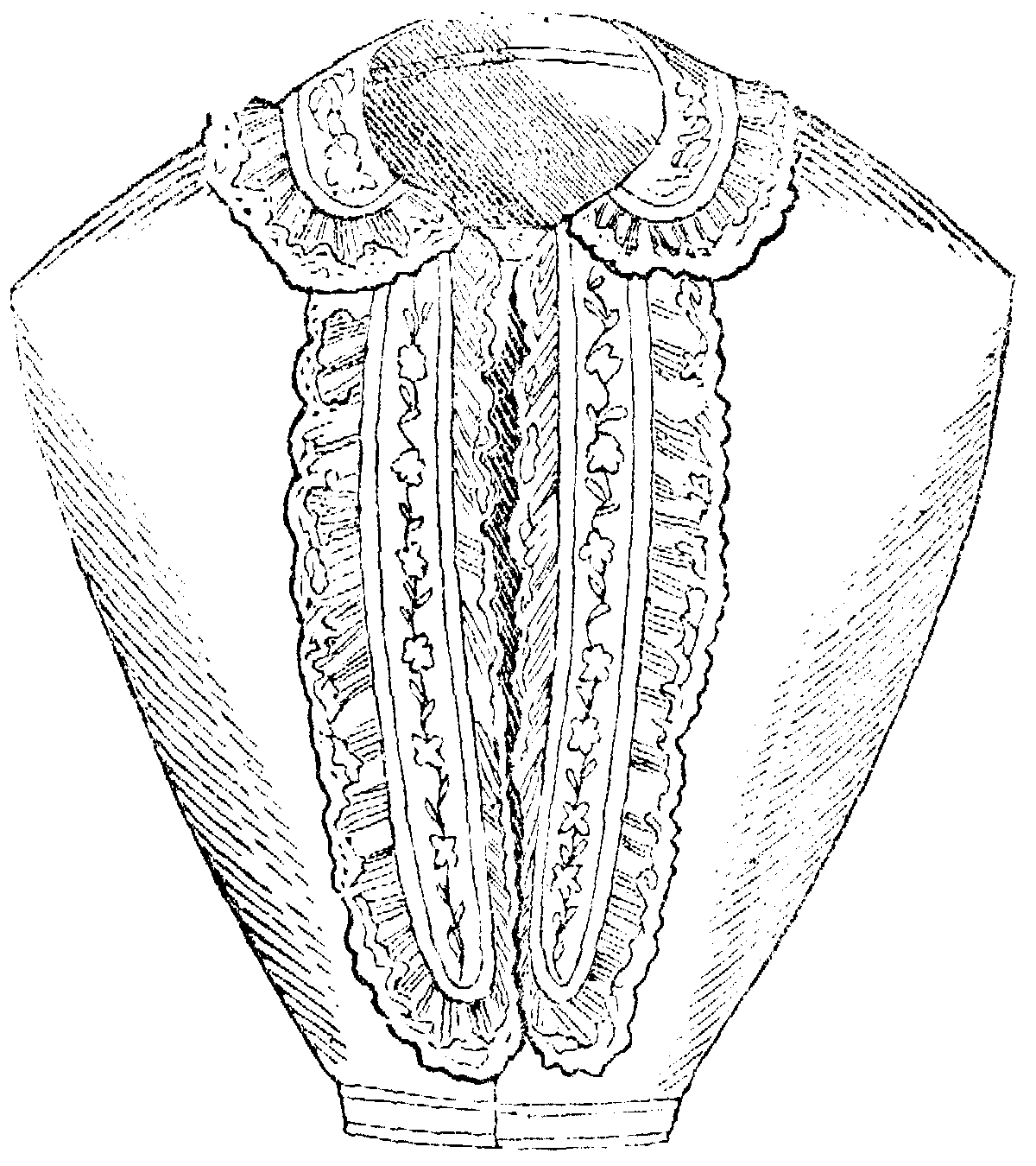
January 1854

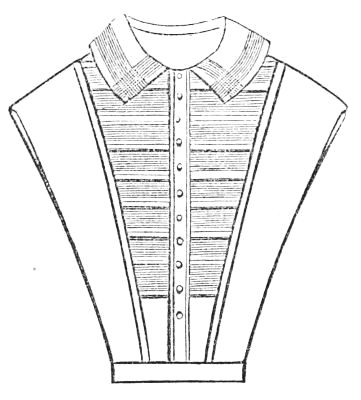
“By the way, I do not know if I mentioned to you the new style of habit-shirt and sleeve which are so much worn in morning toilette. In case I have not, I send you a specimen. The collars[57] have a hem about half an inch wide, stitched all round. Above this are eight, ten, or even twelve minute tucks, run with exquisite neatness. The front of the habit-shirt corresponds, being made one wide tuck and the same number of narrow ones as are in the collar, alternately run from the throat to the waist. A piece of muslin goes down the front, with a broad hem at each edge, a few narrow ones close to them, and a row of ornamental buttons down the front. The sleeves, which are à la duchesse, have the band composed of small tucks, and a frill nearly four inches wide, but slightly sloped towards the join, made to correspond with the collar and habit-shirt.”
“In articles of fancy there is little to remark, this being emphatically the dull season. Bags, however, are almost universally used for carrying the handkerchief, and purses for holding the money. I must say I am glad of this; those clumsy, ugly, porte-monnaies, with their clasps that never would fasten, were always my aversion. You will say, why did I use them?”
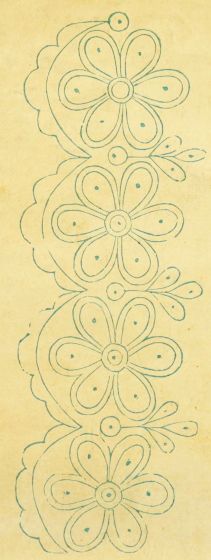
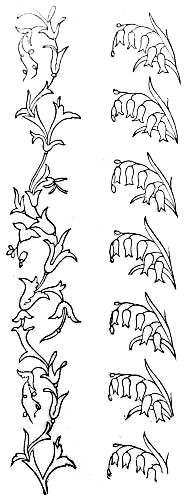
Embroidery for Petticoats 1854
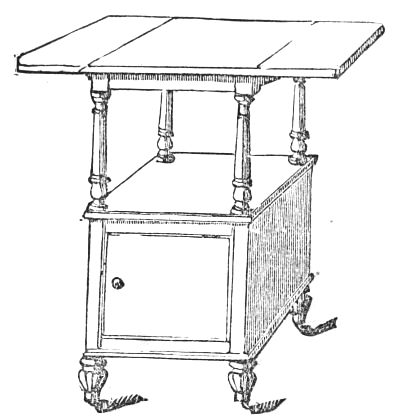
PARLOR WORK.
‘The pleasant old fashion of centre-table work has been revived, except in New York City, perhaps, where, save in some secluded circles, every one seems bent on disproving the preacher’s proposition: “To everything there is a season, and a time to every purpose under the heaven.”
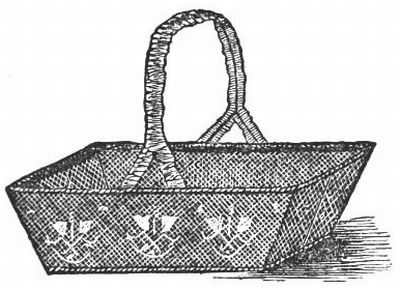
“In the busy whirl of the metropolis, there is little leisure for domestic enjoyment. It is not even known when sleeping is accomplished; and eating, at least the one comfortable meal they allow themselves, is crowded between daylight and dark, at “blind-man’s holiday.” But in Boston and Philadelphia, in all sober country towns and villages, where pleasant society can be had, the work-basket makes its appearance upon the round-table once more, and chit-chat is stimulated by busy hands.
“Nice plain sewing, not so fine as to injure the eyes, nor so large as to encumber either the workwoman or visitor, is always a graceful, womanly resource. It does not distract the attention, and many wearisome stitches may be set unconsciously, thus lightening hours devoted to real task work.
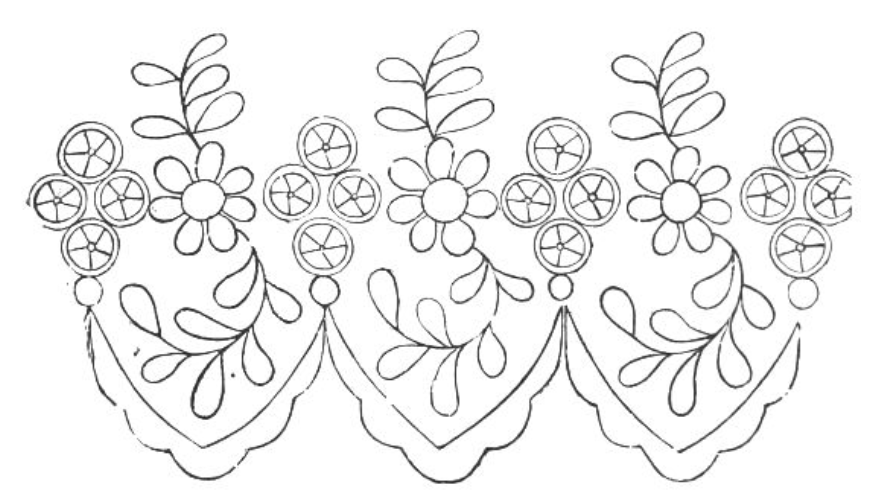
“We would not advise embroidery as an evening occupation, for the reason that, in most cases, it is a strain upon the eyes, to be felt sooner or later. Embroidery is, nevertheless, very fashionable just now; cotton embroidery for infants’ shirts and petticoats; for pocket-handkerchiefs, and the bands and sleeves of underclothes. The patterns are, in general, points or scallops, enriched with eyelets or dots in rows, stars or diamonds; sprays, light wreaths, and even the elaborate work to be found at Bradbrook’s, where a single garment, with an embroidered[90] yoke, is valued at $13, are also in use. Worsted embroidery is chiefly used for flannels, sacques, and skirts, or blankets for infants. Silk is also chiefly fashionable in the wardrobes of children, their dresses, tunics, sacques, and cloaks. For older persons, it is nearly superseded by the use of broad braids, ribbons, and galoons as trimmings.
What is a Galloon?
“Worsted knitting is a favorite and appropriate branch of parlor industry. Opera shawls are very fashionable the present season, a plain centre, with a band of white, or some contrast on the two sides, and a border of points or scallops in the principal color.
What is a Rigotte?
rig-oh-let) is a woman’s light, scarf-like head covering that is typically knit or crocheted from wool. The term was famously popularized in the 1840s, derived from a character named Rigolette in Eugène Sue’s serialized French novel The Mysteries of Paris. Oxford English Dictionary
“Rigolettes, or worsted caps, of every description, for evening wear, carriage boots, half handkerchiefs or spencers, to be worn beneath cloaks and shawls, infants’ shirts, socks, sacques, and aprons, are included in the ample list. For many of these, directions will be found in the “Lady’s Book” from month to month, and novelties are always in preparation for our centre-table circle. Crochet and or \\namental netting, slippers, chairs, and ottomans of worsted work, are still in vogue.”Gl]
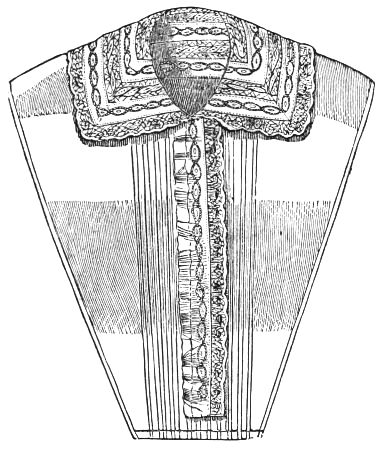
Chemisette January 1854
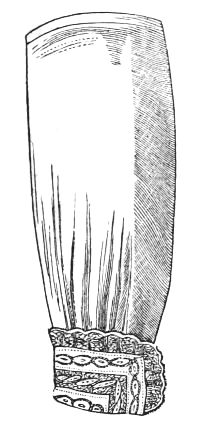
Matching Sleeve January 1854
“It will be noticed that we have adopted the excellent fashion of the “Moniteur,” and now give an undersleeve and chemisette to correspond. No French woman would be guilty of wearing a collar of one style and sleeves of another, yet our countrywomen constantly commit this breach of toilet etiquette.
“Figs. 1 and 2 are one set, intended for winter wear, as will be seen from the close cuff of the sleeve; it is composed of lace insertion and edging. The large square collar has superseded the frills, bands, and even the deep-pointed mousquetaire of the past season.”
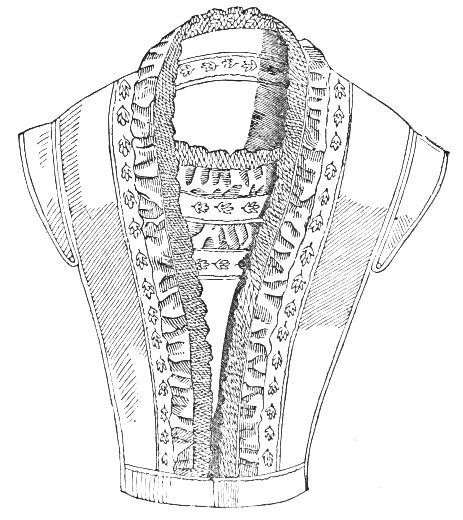
Chemisette January 1854
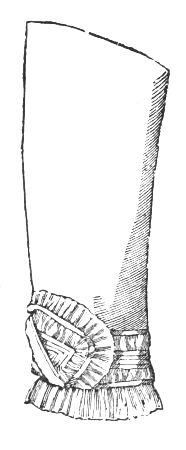
Non Matching Sleeve January 1854
Figs. 3 and 4 are in excellent taste though of[70] different styles. The chemisette and sleeve are composed of Swiss muslin, insertion, and edging.
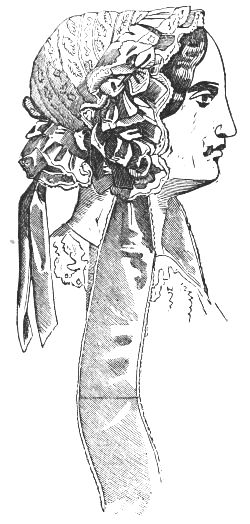
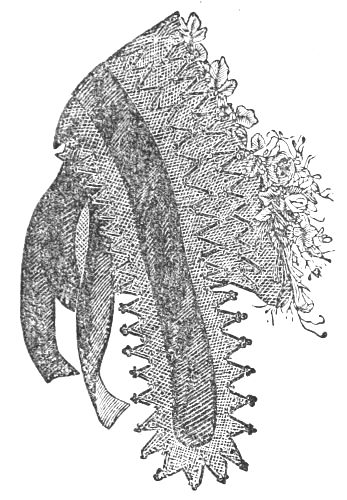
Breakfast Cap January 1854
Fig. 5 is a breakfast cap of alternate Swiss muslin insertion, the frill and fall surrounding the face; an old style reintroduced. Coques of ribbon separate it, and there are strings of the same.
Rigolettes, or worsted caps, of every description, for evening wear, carriage boots, half handkerchiefs or spencers, to be worn beneath cloaks and shawls, infants’ shirts, socks, sacques, and aprons, are included in the ample list. For many of these, directions will be found in the “Lady’s Book” from month to month, and novelties are always in preparation for our centre-table circle. Crochet and ornamental netting, slippers, chairs, and ottomans.” January 1854
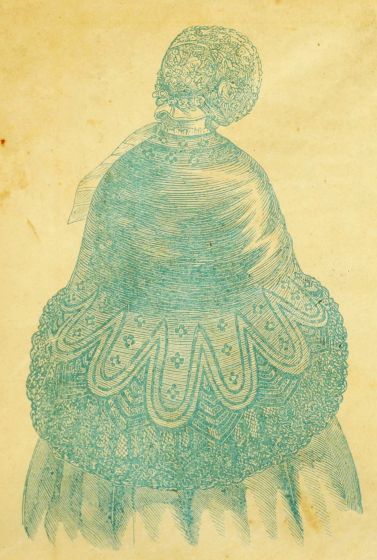
THE HORTENSE MANTELET AND THE VICTORIA.
January 1854
THE HORTENSE MANTELET.
The form is round and exceedingly small. The body of the mantelet is of very rich emerald green satin. The edge is cut out in large rounded points, bordered with three rows of narrow black velvet, and on each of the points are fixed three ornaments of cut black velvet in straight rows. The intervals between the satin points at the edge of the mantelet are filled up by Brussels net, covered with rows of narrow black velvet. The Brussels net is cut out in pointed vandykes, each vandyke being between the rounded points of the satin. The whole is finished by a deep fall of black lace, set on full. The neck of the mantelet is trimmed with rows of narrow black velvet, and cut ornaments, the same as those on the points at the lower part.
January 1854
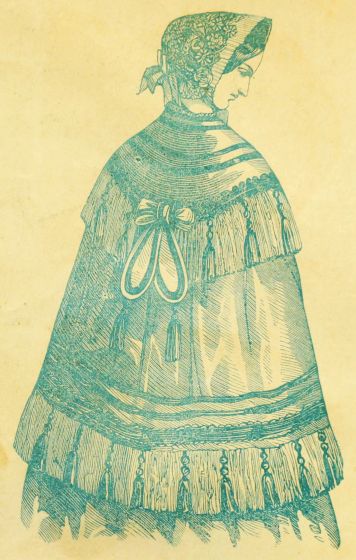
THE VICTORIA.
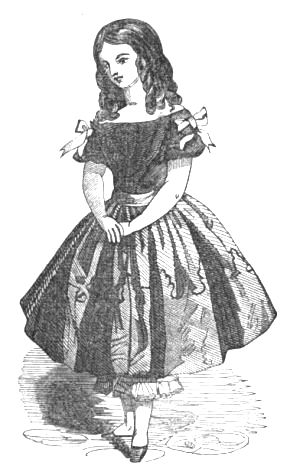
Child’s Dress January 1854
BRAIDING ROUND DRESS.
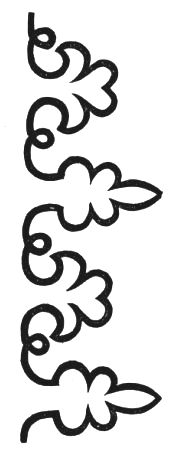
This is a very pretty light dress for a little girl. The material used may either be a light silk or French merino; the trimming a narrow silk braid, which, according to the taste of the maker, may be extended down the body and round the sleeves.
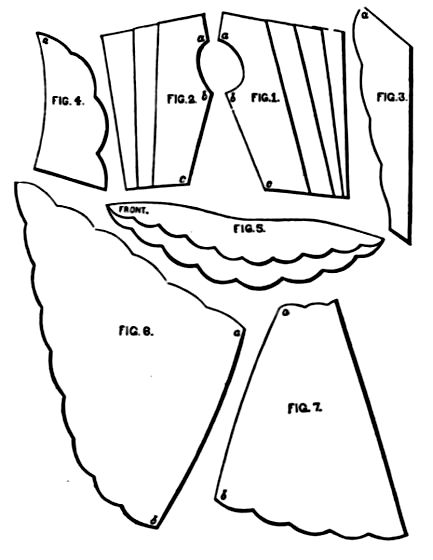
DESCRIPTION OF DIAGRAMS.
Fig. 1 represents the front of frock.
Fig. 2 the back of frock. Join a to a (Fig. 1), b to b, c to c.
Fig. 3.—Piece cut out for trimming down the front.
Fig. 4.—Piece to join at a to a (Fig. 3), to form trimming down the back.
Fig. 5.—Pattern of sleeve, the narrow part of which should fall on shoulder.
Fig. 6.—Front of mantle.
Fig. 7.—Back of mantle. Join a to a (Fig. 6), b to b.
Discover more from Jacki Kellum
Subscribe to get the latest posts sent to your email.