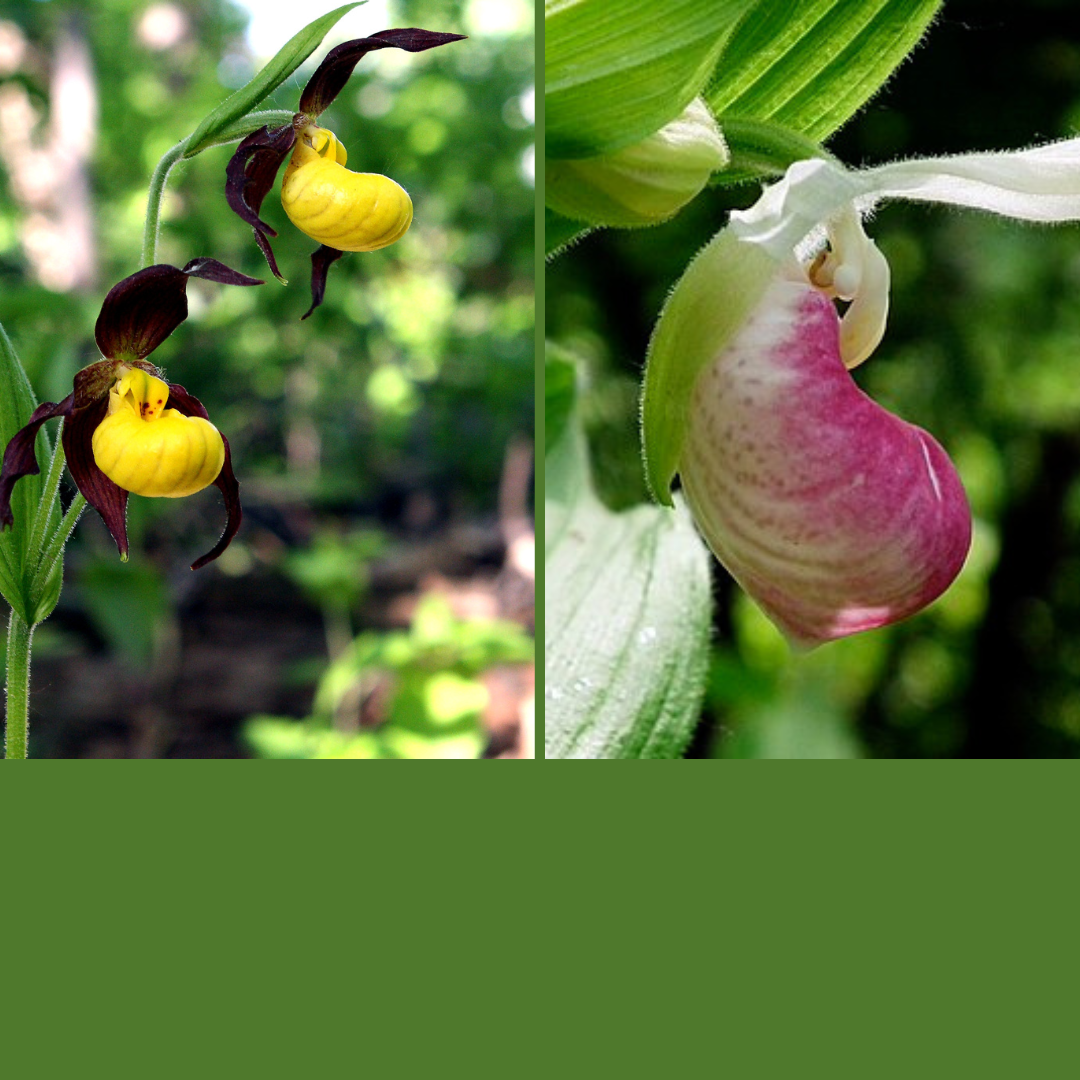
Lady’s Slippers
Scientific Family: Orhidaceae
Cherokee Name: k‛kwĕ΄ ulasúla
“Meaning of the Cherokee Name: ‘partridge shoe’
The Cherokee name, K‛kwĕ΄ (‘partridge’) Ulasúla (‘shoe’ or ‘moccasin’), has the same
basis as the common name lady’s-slipper. This is due to the pouch-like sac which looks like a shoe, moccasin, or slipper.
Uses:
“It is believed the Cherokee didn’t differentiate between the pink and yellow variety or the
large and small variety of the yellow. Pink lady slipper roots were boiled into a thick decoction and given to children for worms. Both varieties were collected and sold to white traders. The pink lady slipper was used for stomach cramps when it was combined with a species of Sanicula.
“Lady slipper roots of were made into a tea for nervous conditions, kidney problems or it was combined with Comandra umbellate. A tea from these roots could be used for “female
problems” such as menstrual irregularities and menopausal changes. Four whole plants were used to create a tea which was said to relieve hernia pain in men and women. A root tea of the large yellow variety had many applications including colds and flu, kidney problems, nervous conditions, high fevers, and stomachaches. All three types of roots could be made into a decoction and drunk for diabetes. combined with Comandra umbellate. A tea from these roots could be used for “female problems” such as menstrual irregularities and menopausal changes. Four whole plants were used to create a tea which was said to relieve hernia pain in men and women. A root tea of the large yellow variety had many applications including colds and flu, kidney problems, nervous conditions, high fevers, and stomachaches.” Highlands Biological
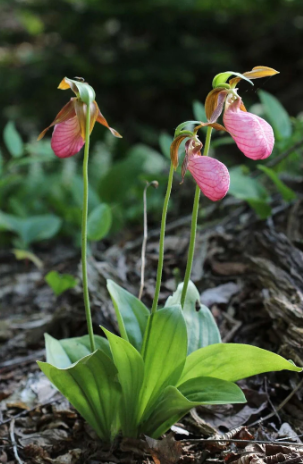
Pink Lady’s Slippers
Image Credit: Todd’s Native Nursery
“Pink lady’s slipper is a large, showy wildflower belonging to the orchid family. It has two opposite basal leaves with conspicuous parallel veins and a large flower at the end of an erect stalk. The flower is magenta to whitish-pink; sometimes the whitish pink flowers will have darker pink venation. Rarely the flower may be all white. This plant grows 6 to 15 inches tall and flowers generally between May and July.” Todd’s Native Nursery
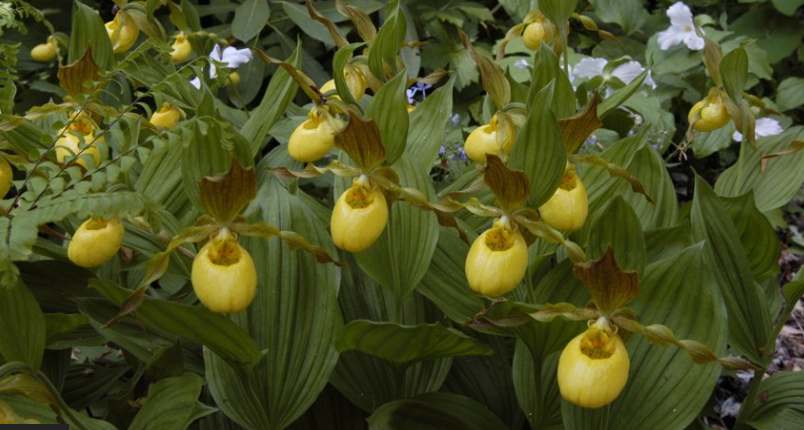
Large Yellow Lady’s Slipper
Image Credit: Mt. Cuba
“Few wildflowers can rival large yellow lady’s slipper (Cypripedium parvi”florum var. pubescens) in mid-May with is attractive pouch-like flowers. This perennial, multi-stemmed orchid bursts into bloom with 2-3″ wide, bright yellow irregular flowers borne terminally on 18″ tall leafy stems. Large yellow lady’s slipper performs best in partial shade with organic, moist, well-drained, and neutral to slightly alkaline soils. In woodlands with bright filtered light,” Mt. Cuba
 |
|
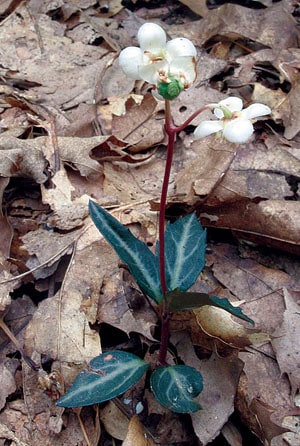
Spotted Wintergreen
Image Credit: U,S, Department of Agriculture
Common Name: Spotted wintergreen
Scientific Name: Chimaphila maculata
Scientific Family: Ericaceae
Cherokee Name: ustăstĭ usdíga
Cherokee Name meaning: ‘he spins’, ‘small’
Uses:
The root of spotted wintergreen was used to make a tea to treat colds, flu, and fever.
Wintergreen roots could be beaten, used as a poultice for headaches and other sources of pain, or made into a tea for menstrual pain. Utastĭ΄ ustí leaves pounded and wrapped in a cloth which was then soaked in water to bathe the eyes of patients who had sore eyes and couldn’t look at the sun.” Highlands Biological
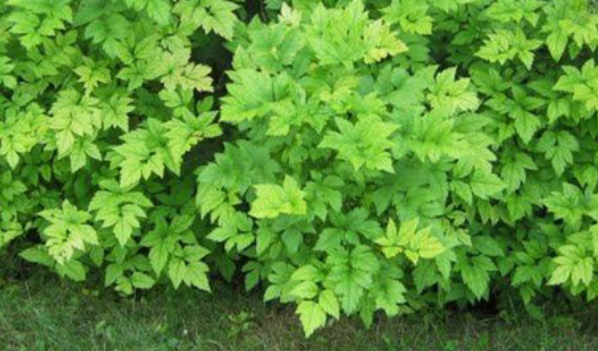
Yellow Root
Image Credit: Plant Addicts
Common Name: Yellow-root
Scientific Name: Xanthorhiza simplicissima
Scientific Family: Ranunculaceae
Cherokee Name: dalâni amayułtehi
Meaning of the Cherokee Name: ‘yellow, water edge growing’
“This plant got its’ name Yellowroot by the intense yellow color that was apparent when
the bark is removed from the stem and roots which allowed them to receive the name Dalâni (Dalânige). The next part of yellowroots Cherokee name is Amayułtehi which mean ‘water edgegrowing’, this refers to the preferred habitat of this species which is commonly found growing near mountain streams.
Uses:
Yellowroot produces a bloody juice called Atat‛aski which is an important medicine in
the Cherokee. Dalâni amayułtehi was used as a decoction and was blown on the head, breast, and palm of each hand of a birthing mother. It could be used to cure for when they were urinating blood or diarrhea. The roots were used by steeping them, then holding them in their mouth to cure thrush. Scraped off bark poultice could be used to relieve sore eyes. By chewing on the roots or an infusing, it would alleviate a sore mouth. The roots could also be added to mutton tallow to create a salve. Roots made into a tea would calm nerves or alleviate cramps. If Dalâniamayułtehi was combined with Asarum canadensis, Goodyera pubescens, Alnus serrulata, and Prunus serotina it was used as a blood tonic and would increase the appetite. However, Yellowroot didn’t just only have medicinal properties but was used as the primary source of yellow dye to color white oak baskets, masks, bows, and other objects. Earlier in the 19th century it was used with black oak bark to color ceremonial feathers to turn them “a most brilliant yellow.” Highland Botanicals
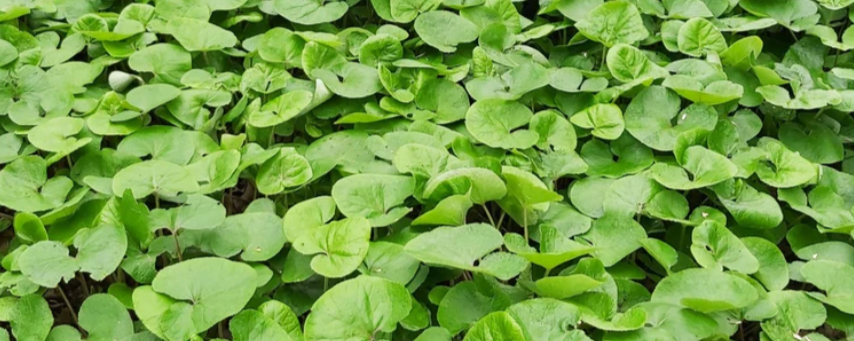
Wild Ginger
Image Credit: Tennessee Nursery
Common Name: Wild ginger
Scientific Name: Asarum canadense
Scientific Family: Aristolochiaceae
Cherokee Name: nuyagûlĭ΄Meaning of the Cherokee: ‘it climbs the rocks’
“Wild ginger’s Cherokee name comes from nû΄ya meaning ‘rock’ or ‘stone’ and gûlĭ΄
meaning ‘it climbs’ which is another form of tsĭlahĭ or tsĭlĭ ‘I am climbing’, this refers to its
ability to grow on moss covered rocks.
Uses:
A hot infusion made out of bruised roots was used for coughs, or the root could be
chewed. The roots of nuyagûlĭ’ was also dried for future use. A formula using the leaves were used with Alnus serrulata, Carpinus caroliniana, and Sassafras albidum for old sores and cancers. It was also used for aninedzi ada‛nöwoti tuksinigöwayö nategsöi (‘their breast, to cure anyone with, terrapin does it to them, as they go about’), aninedzi gotiski (‘their breast swells’), and yöwi tsunstia göwani skastane‛öi (‘when the little people frighten them’). Wild ginger was also used for milky urine. Sores in the abdominal region were treated with roots made into a decoction and blown over the afflicted region with a tube. Nuyagûlĭ΄ was an herb sold for commerce to white herb buyers. Roots and A. canadense would be made combined into a tea consumed for heart trouble, menstrual irregularity, and colds. A decoction of heartleaf combined with Goodyera pubescens, Alnus serrulata, Prunus serotina, and Xanthorhizasimplicissima wasused for a blood tonic and to improve the appetite. Dried leaves of wild ginger were also used as snuff, while fresh leaves were used for healing wounds.” Highlands Biologicals
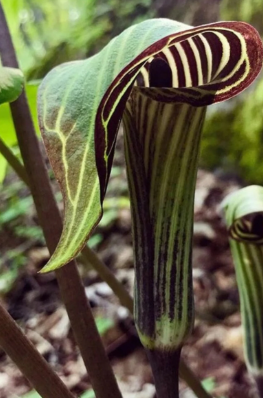
Jack in the Pulpit
Image Credi: Collins River Plants on Etsy
Common Name: Jack-in the-pulpit
Scientific Name: Arisaema triphyllum
Scientific Family: Araceae
Cherokee Name: túyastĭ΄
Meaning of the Cherokee Name: ‘a boil or carbuncle’
The name “Indian” in Indian turnip was used to mean “counterfeit” or “treacherous”
which was similar to terms as “Indian giver” or “Indian summer”, meaning the plant was
considered poisonous when consumed.
Uses:
However, the roots would be “boiled to remove the strong smart taste, and then mashed
with the hands, mixed, or kneaded like dough and then baked or fried like other dough. Jack-in the -pulpit roots were dried along with a small quantity of walnut bark pounded together and placed in the center of a boil (known as tústĭ). Turpentine collected from pine trees and used as ointment along with the pounded herbs, which was covered with cloth or paper until it washealed. Turpentine from pine tree was used as an ointment to heal a wound so it wouldn’t leavea scar. Túyastĭ΄ roots would be made into a poultice for headaches. Roasting roots for short time and then rolling into small grape sized balls would be eaten. Anywhere from 2, 3, 4, or 7 of theballs would be eaten at a time for kidney problems.” Highlands Biologicals
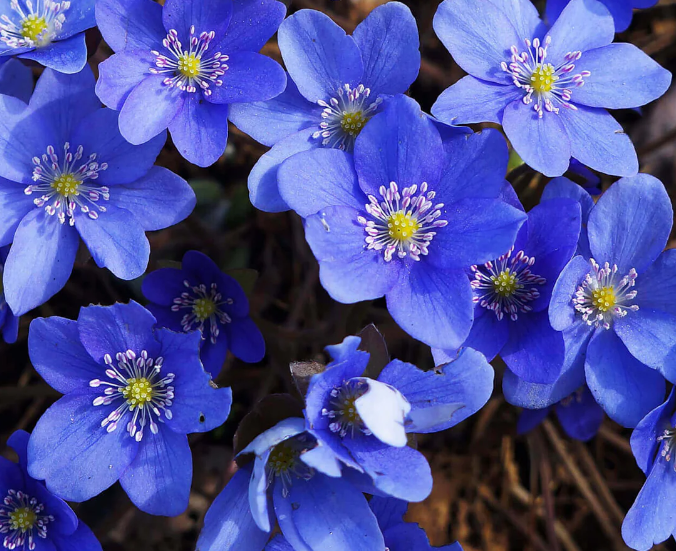
Liverleaf
Image Credit: Wholesale Nursery
Common Name: Liverleaf
Scientific Name: Hepatica acutiloba
Scientific Family: Ranunculaceae
Cherokee Name: skwálĭ usdí-ga
Meaning of the Cherokee Name: ‘small liverleaf’
The Cherokee name for liverleaf stems from the word uskwâ΄lĭ meaning ‘stomach’.
Uses:
“Roots and leaves were chewed or made into a tea for a person with a cough. Liverleaf
leaves or roots would be combined with Asplenium rhyzophyllum made an emetic or a decoction that was boiled down to ½ its volume for a person who dreamed of snakes. Skwálĭ usdí-ga was used for other conditions such as aninedzi ada‛nöwoti tuksinigöwayö nategsöi (‘their breast, to cure anyone with, terrapin does it to them, as they go about’), aninedzi gotiski (‘their breast swells’), and yöwi tsunstia göwani skastane‛öi (‘when the little people frighten them’). A decoction of could be made and consumed during a new moon to prevent whooping cough.Skwálĭ usdí-ga roots were used as hot tea for bowel complaints, while dried leaves could be used for heart troubles. Dried crushed leaves of Liverleaf were made into a tea for toothaches. Liverleaf was also harvested and sold to white traders, due to the demand in the herb market for their leaves.” Highlands Biologicals
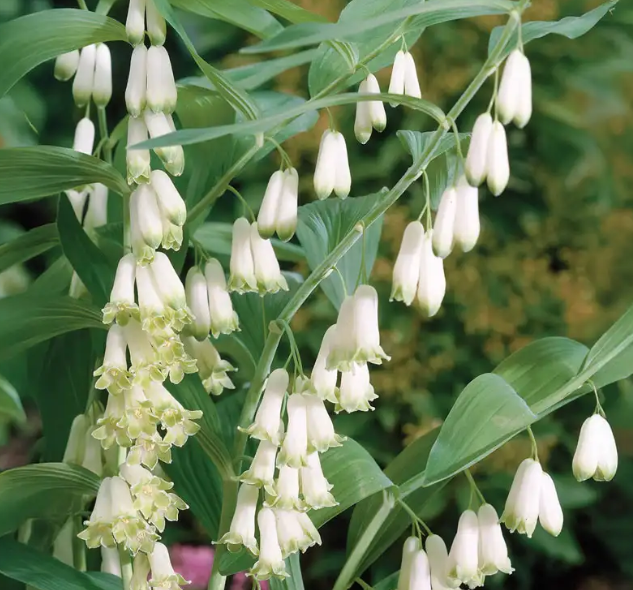
Solomon’s Seal
Image Credit: Brecks
Common Name: Solomon’s seal
Scientific Name: Polygonatum biflorum
Scientific Family: Asparagaceae
Cherokee Name: uganástĭ útana
Meaning of the Cherokee: ‘sweet, large’
Uses:
“Solomon’s seal is the most important food from this folk genus. Solomon’s seal receives
its name from the Cherokee word utístŭgĭ or utĭstkĭ meaning ‘hanging head’ due to the pair of
fruits hanging below the arched stalk. The young shoot of Solomon’s seal was eaten as greens.
The root can be pounded by a corn mortar and added to bread, as a famine food. Uganástĭ útana
roots were roasted and pounded to be applied to boil-like swelling. It could be made into a tea
and consumed for stomach problems as well. Solomon’s seal roots and P. biflorum malong
mixed with soil gathered from the front of a ground hog’s den, were combined and boiled to
make a decoction which was consumed as a medium for emesis to clear “spoiled saliva” due to dreams of the dead. The patient would vomit until all the liquid was expelled; this would be repeated for four straight mornings. Uganástĭ útana was also used for a purple form of a cancerous condition known as ada‛yeski (‘eating itself’” vHighlands Biologicals
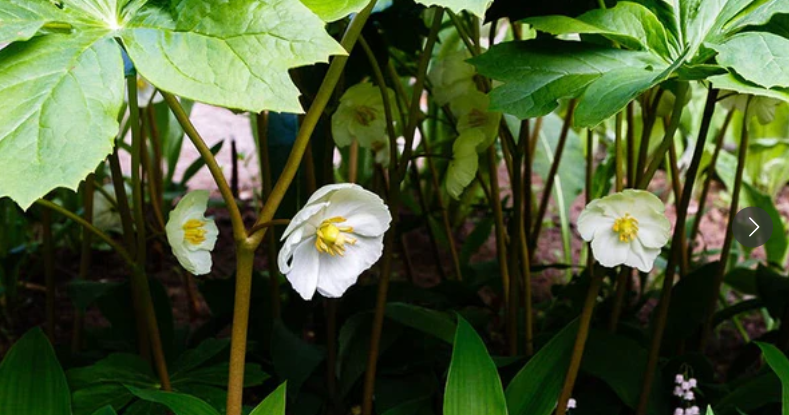
May Apple Plant
Image Credit: American Meadows
Common Name: May-apple
Scientific Name: Podophyllum peltatum
Scientific Family: Berberidaceae
Cherokee Name: uniskwetú‛gĭ tsundí-ga
Meaning of the Cherokee Name: ‘they wear a hat, or they have their heads covered, small’
Uses:
“May-apple roots were combined with black walnut and butternut bark and made into a
strong decoction, which was boiled down four times until it became a thick syrup. Half a teacup full would be consumed at one time as a powerful cathartic. It was thought the patient would
recover at once unless a menstruating woman entered the room, and if they did the patient would
swell up and die. May-apple was used for unisi‛kwaskö (‘when they are coughing’) and a
condition related to dalâni, uniskwotłii tsunitłöyö yuwot‛isö andanawoski (‘when they have a
stomach-ache with swollen and throbbing stomach’). Dried powered roots of Uniskwetú‛gĭ
tsundí-ga or a tea made from them, served as a laxative. Another common use for the roots were to soak them in whiskey and take them for rheumatism. Pounded roots were also soaked in water, and combined with soaked corn seed, resulting in a tea to keep pests from eating the freshly planted corn. A single drop of juice from the root was place in the ear to cure deafness. Some people warned others to only use the portion of the root between the nodes, because thenodes themselves were too poisonous. Nodes were specifically used to poison crows and dogs.
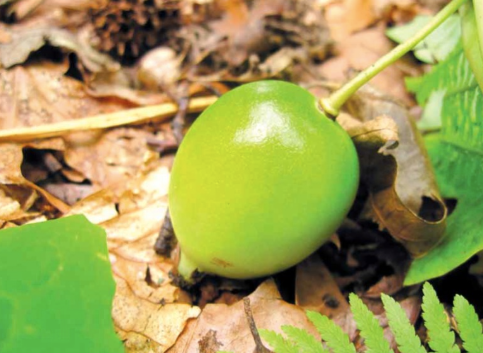
Mayapple
Image Credit: Edible Manhattan
“More conservative Cherokees would avoid the plant all together, believing any vine plant in their garden would wither and die if they tended to their plants after eating the fruit. However, Mayapple fruits are edible.” Highlands Biological
https://highlandsbiological.org/wp-content/uploads/2019/07/Plant-webpagee3.pdf
Discover more from Jacki Kellum
Subscribe to get the latest posts sent to your email.